 0161 962 7261
when to bring a kitchen designer into your extension project, and why earlier is better
Quick answer: The right time to involve a kitchen designer in an extension project is at the concept stage: before planning permission is submitted, and well before building regulations are drawn up. Most homeowners bring a designer in after the shell is built. By that point, services are often in the wrong position, glazing has eaten up valuable wall space, and ceiling decisions have ruled out the tall units that make a kitchen practical. Undoing those problems costs far more than a single early-stage conversation ever would. Not sure which German kitchen brand is right for you? We’ve broken down the differences between Schüller, Keller and Next125 in plain English.
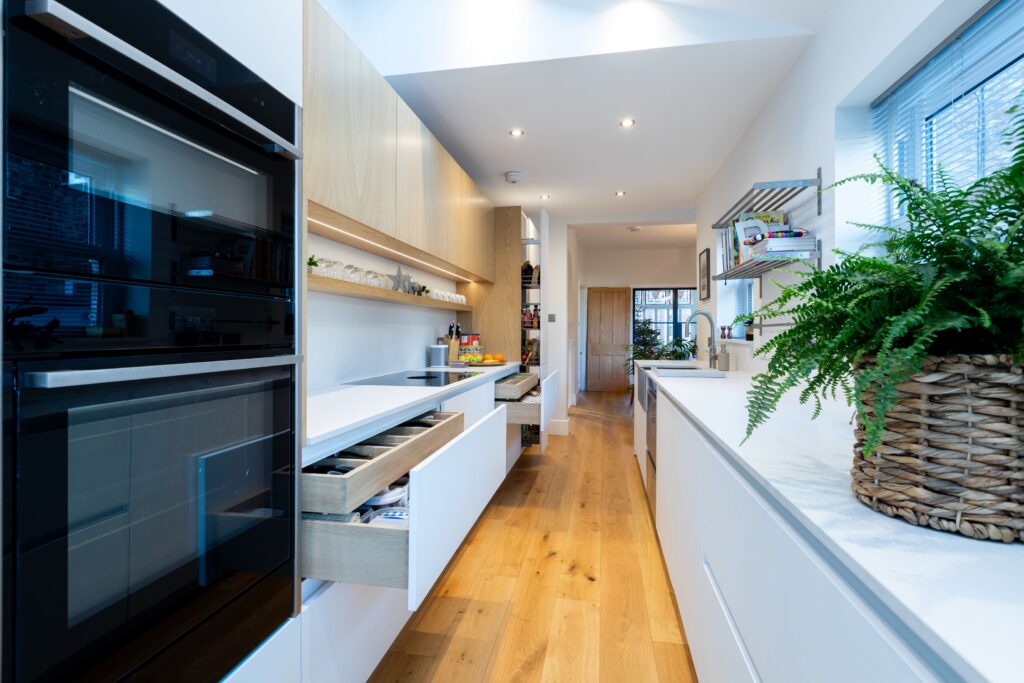
If you’re planning a rear extension and a new kitchen, you’ve probably assumed there’s a natural sequence: get the structure sorted first, then bring in the kitchen designer once the shell is up. It’s logical. It’s also one of the most costly mistakes extension homeowners make.
This article is for anyone in the early stages of an extension project, whether you’re still talking to architects, or you’ve recently received planning permission. It explains why involving a kitchen designer at concept stage leads to better outcomes, fewer surprises, and a kitchen that actually fits the space you’ve gone to the trouble of building.
why most homeowners involve their designer too late
The typical sequence goes: appoint an architect, get planning permission, hire a builder, and then, somewhere around first fix, start thinking about the kitchen. By that point, structural decisions have been made without any kitchen input. Sockets are where the electrician thought they should go. The gas inlet is on the wall the extractor needs. The ceiling is flat in the one corner where you wanted tall units.
None of this is anyone’s fault individually, it’s a coordination gap, and it’s almost entirely preventable. The RIBA Plan of Work places concept design at Stage 2. That’s precisely where kitchen input belongs. Arriving at Stage 4 (technical design) with no kitchen brief is where the problems begin.
what goes wrong when services end up in the wrong position
Gas, water, drainage, and electrics are inexpensive to position correctly at the pre-build stage. They’re expensive to move after first fix. Relocating a misplaced gas inlet post-plaster typically costs £800–£1,500 once you account for the gas safe engineer, replastering, tiling, and decoration. A soil stack in the wrong corner can make a planned sink run impossible without significant re-routing. Sockets that land behind planned cabinetry need re-chasing, and the walls closed up around them.
A kitchen designer working with your architect at concept stage can produce a services overlay: a drawing showing exactly where every outlet, pipe, and drain needs to land. Given to the builder before groundwork begins, it takes minutes to act on. Given after first fix, it costs days, and the knock-on programme delays can affect the whole project. If you’re wondering why German kitchen cabinets are worth the investment, the quality of the construction tells the whole story.
how glazing decisions can eat your wall space
Glazing is where extension design and kitchen design most often clash. Bifold doors, rooflight panels, and full-width glazed rear walls look exceptional on an architect’s elevation. They also meaningfully reduce the wall run available for cabinetry.
A typical rear extension rear wall might be 5,000mm wide. A standard set of bifolding doors can occupy 3,600–4,200mm of that. What remains is often insufficient for the kitchen layout the homeowner had in mind — without early planning. The fix isn’t to compromise on the glazing; it’s to plan both at the same time. A kitchen designer can specify the minimum wall run the layout requires, and work with the architect to position the glazing so it serves both the light and the kitchen, rather than one at the expense of the other.
the ceiling-height issue that rules out tall units
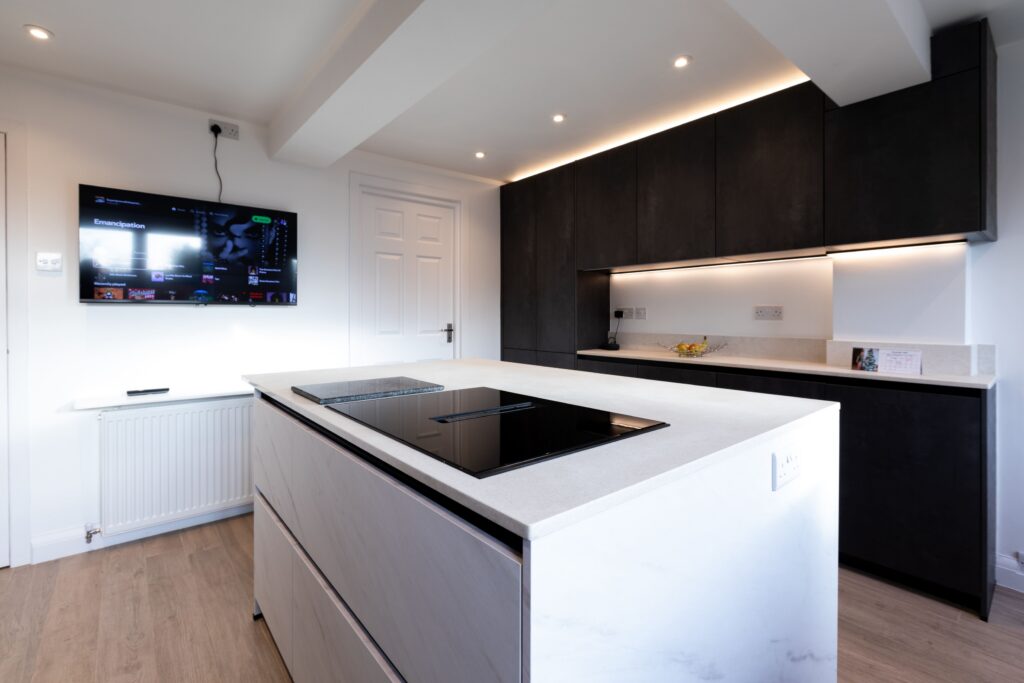
Flat-roof extensions with ceilings at 2,400mm or above typically accommodate tall larder units and integrated column appliances without difficulty. Vaulted ceilings, pitched glazing, or structural beams that drop at a specific point can make tall units impossible in exactly the areas where they’d be most useful.
Similarly, MVHR systems, common in well-insulated modern extensions, require ducting above the ceiling. Without early coordination, that ductwork can reduce the usable ceiling height precisely where you wanted cabinetry. Knowing this at Stage 2 means it can be designed around. Discovering it at cabinet installation means compromise.
The table below shows the most common late-involvement problems and what each costs to address:
| Problem | Caught at concept stage | Caught after first fix |
|---|---|---|
| Gas inlet in wrong position | No cost, specify correctly on drawing | £800–£1,500 (re-routing, replaster, redecorate) |
| Glazing eats wall run | No cost, reposition on architect’s drawing | May be unfixable; kitchen layout constrained |
| Ceiling drop rules out tall units | No cost, design around structure | Loss of tall-unit storage; replacement not possible |
| MVHR ductwork drops ceiling | Designed around in soffit planning | Units ordered to wrong height; reorder required |
| Sockets behind planned cabinetry | Services overlay prevents the clash | Re-chasing, replastering, redecorating |
how the designer–architect–builder triangle should work
The best extension kitchen projects involve all three parties communicating from the outset. In practice, this doesn’t mean expensive ongoing involvement from the kitchen designer at every build meeting, it usually means one structured conversation at concept stage, a services brief issued to the architect, and a confirmation visit at first fix before the walls close up. That’s it. Three touchpoints. A significant proportion of the problems that derail extension kitchens are avoided.
Most architects welcome early kitchen design input. It makes their drawings more accurate, reduces site queries, and means the homeowner is less likely to request changes once the build is underway. The coordination overhead is minimal; the benefit is substantial. After your kitchen is installed, it’s worth knowing what aftercare to expect and how to keep everything in top condition.
common mistakes to avoid
- Finalising the architect’s drawings before briefing the kitchen designer. Building regs drawings are expensive to change. Kitchen services input belongs at the concept stage, before those drawings are submitted.
- Assuming the builder will know where services should go. A good builder builds to the drawing. If the drawing doesn’t specify kitchen service locations, the builder makes a reasonable guess – and reasonable guesses are rarely the right ones.
- Choosing glazing for aesthetics before checking the wall run. Bifolds and rooflight panels are excellent design choices. They need to be coordinated with the kitchen layout, not specified before it.
- Ignoring structural ceiling elements. Beams, drops, and vaulted sections all affect cabinet heights. These need to be known at design stage, not at installation stage.
- Not confirming appliance specifications before first fix. Appliance dimensions determine socket and isolator positions. A spec change after first fix means a change to the electrics – with all the cost and delay that entails.
frequently asked questions
Should the architect choose the kitchen layout?
Not typically. Architects design the structure and envelope – they’re not kitchen specialists. Most architects value early input from a kitchen designer on services positions, wall runs, and ceiling heights, and will incorporate that information into their drawings. The kitchen layout itself is specialist work; the best results come from both disciplines collaborating at concept stage, rather than one handing over to the other.
Can the kitchen designer brief the architect directly?
Yes, and it’s often more efficient than the homeowner acting as the go-between. A kitchen designer can produce a services overlay and a zoning brief that feeds directly into the architect’s drawing package. That cuts out the version of events that arrives garbled – the telephone-game translation that leads to services in the wrong position.
When is it too early to involve a kitchen designer?
There’s no such thing as too early. Even at the first sketch stage, a single conversation to understand wall-run requirements, ceiling height needs, and services positions costs nothing and prevents problems. If you’re thinking about an extension and a new kitchen, involve the designer at the same time as the architect.
Do most homeowners bring kitchen designers in too late?
In our experience at Suga Küchen, the majority of extension clients first contact us after the shell is built. In many of those cases, we can still produce an excellent kitchen – but the options are more constrained than they would have been with early involvement. The clients who involve us at concept stage consistently report a more straightforward project and a result that more closely matches what they originally envisaged.
What if I already have planning permission – is it too late?
Probably not. If building regulations haven’t been submitted yet, there’s still time to incorporate kitchen services requirements and ceiling height considerations. Even once the structure is agreed, first-fix services can often be repositioned before the walls close up – provided the kitchen designer is involved before that stage, not after.
start the conversation early
Wherever you are in your extension plans, a short conversation with one of our designers can save weeks of second-guessing. Chat with a designer – no pressure, no sales pitch, just practical guidance grounded in real installation experience.
Written by Cassandra Wilkinson-Leonard, Senior Designer, Suga Küchen. Last updated 28 May 2026.