 0161 962 7261
schüller, keller or next125? a plain-english guide to the three german kitchen brands
Quick answer: All three are premium kitchen brands stocked at Suga Küchen, but they suit different homes and budgets. Schüller offers the broadest range of styles and price points, making it the most flexible choice for varying briefs. next125 is Schüller’s architectural sister brand for minimalist, design-led projects. Keller is a Dutch-manufactured brand with strong sustainability credentials and a more restrained contemporary aesthetic. None of them is wrong. The right choice depends entirely on the brief.
Most homeowners arrive at a kitchen showroom having encountered at least one of these names – and often without a clear sense of how they differ. Schüller, Keller and next125 are not interchangeable. They have distinct design languages, different manufacturing stories, and they suit different types of home and lifestyle. Choosing the wrong brand early in the process can mean a kitchen that is technically very good but never quite feels right for the space it sits in. This guide is designed to give you a plain-English account of each brand: where it comes from, what it looks like in real kitchens, how it is priced relative to the others, and who it genuinely suits – so that by the end you have a clearer sense of which conversation to start.
what schüller brings to the table
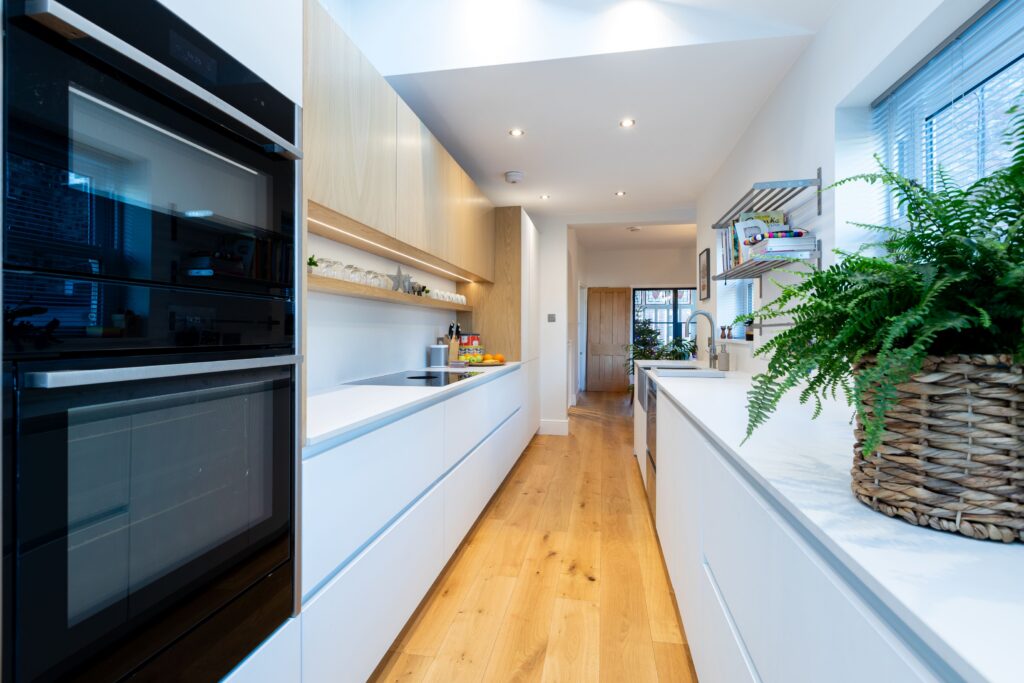
Schüller is among Germany’s largest kitchen manufacturers. Founded in 1966 in Herrieden, Bavaria, it has remained family-owned – a detail that is more than background colour. Family ownership means the company makes decisions on the basis of long-term product integrity rather than short-cycle commercial pressure, and the Schüller range reflects that. Over six decades the product line has grown into something unusually broad: more than 40 door styles, hundreds of finish options, and a configuration system capable of producing kitchens that look and feel nothing like each other. A warm, timber-fronted Shaker-inspired design and a sleek, all-white handleless kitchen can both be a Schüller – and both will be built to the same carcass standard.
In terms of price, Schüller sits firmly in the mid-to-upper tier of the UK market. A fitted Schüller kitchen at Suga Küchen typically starts around £20,000–£25,000 for a more modest project and can reach £45,000–£55,000 for a larger, fully specified family kitchen. The build quality – 19mm carcasses, Blum and Hettich hardware, laser-edged doors – holds up in a way that mass-market alternatives do not match. You can read more on those engineering specifics on the Schüller website, though the difference is most legible in person. For renovation advice, explore How to Plan a Kitchen for an Extension or Knock-Through Without Things Going Sideways.
Where Schüller shines is flexibility. It is the brand we reach for when a client knows they want German-engineered quality and a good finish, but whose brief is still taking shape – or who has a design direction that does not fit neatly into one aesthetic camp. It handles both warm, lived-in kitchens and clean, minimal ones with equal competence. Where it is less well suited is when a client wants an overtly architectural statement – a kitchen that commands a room rather than blends into it with great confidence. For that conversation, next125 is the more natural starting point.
Who Schüller suits: families planning a long-term primary kitchen; homeowners who want maximum design flexibility; renovation projects where the brief is evolving during the design process; clients who want German build quality across a wide range of aesthetic directions. See our German kitchens in Altrincham page for more on how we work with Schüller.
what keller actually is, and why the origin story matters
There is a piece of useful honesty worth stating clearly here: Keller is not a German brand. It is Dutch. Founded in Pijnacker in the Netherlands in 1946, Keller Kitchens has been manufacturing cabinetry for nearly eighty years, with a production philosophy that shares significant common ground with German cabinetry – made to order, precision-engineered, no flat-pack – but with a distinct heritage and a different sustainability story. We think clients should know this. It changes nothing about the quality of the finished product, but it does affect supply chain transparency, which matters to a growing number of homeowners.
Keller’s environmental credentials are genuinely strong and represent a real point of difference. The brand is PEFC-certified, meaning the wood-derived materials come from sustainably managed forests, and its manufacturing is structured to reduce both energy use and material waste. For homeowners who weigh sustainability alongside aesthetics and budget, this is not marketing language: it is a verifiable commitment that the brand is willing to be held to.
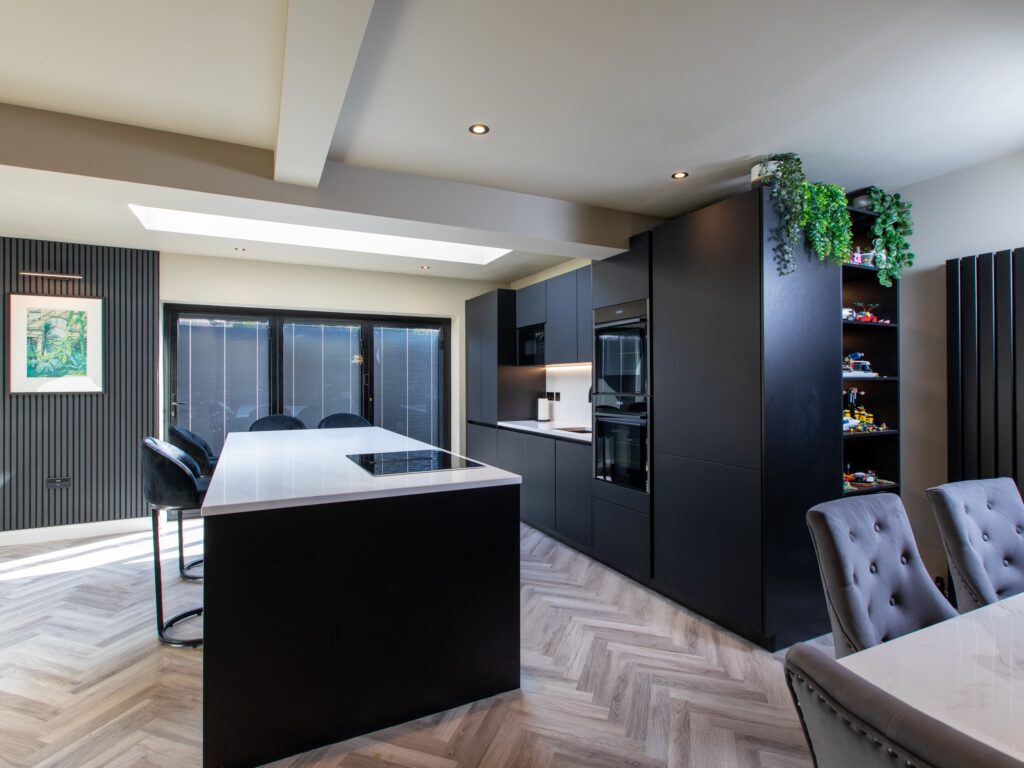
Design-wise, Keller is more restrained than Schüller. The door range is narrower, roughly 20–25 styles compared to Schüller’s 40-plus, but what it does, it does with considerable consistency. The brand is strongest in matt slab doors, muted earthy tones, and the kind of quiet contemporary look that photographs well and lives comfortably over many years. It is not a brand for those who want high-gloss drama or a detailed Shaker with visible grain. It suits homeowners who want a kitchen that recedes gracefully into the background of a well-considered interior.
Price-wise, Keller runs broadly comparable to Schüller at entry and mid-range. The upper end of the Keller range is typically somewhat more accessible than the upper end of next125, which makes it a practical option for those who want European precision manufacturing without the premium of next125’s more complex finishes.
Who Keller suits: sustainability-conscious buyers; homeowners who value a calm, restrained aesthetic; clients who want a genuinely well-made kitchen without the breadth of options that Schüller offers and the complexity that comes with it.
next125: the architectural choice
next125 was established in 2010 as Schüller’s design-forward sub-brand, and it is manufactured in the same factory in Herrieden, Bavaria. The same German carcass engineering applies: 19mm boards, Blum hardware, laser-edged doors – but the design language is entirely different. Where Schüller casts wide, next125 is deliberately narrow: a curated collection of doors and materials aimed at homeowners for whom the kitchen is a design statement, not a background fitting.
The defining characteristic of next125 is restraint taken to a high level. The NX 902 recessed-handle system produces a door face that is entirely uninterrupted, no visible handle, no rail, simply a clean plane of material with a subtle integrated finger recess. This is not achieved by removing hardware from a standard door; it is engineered into the door profile itself. The same precision applies to the material palette: ultra-matt lacquers in controlled tones, back-painted glass, large-format ceramic, and real-veneer wood. The range is tighter than Schüller by design, the intent is coherence, not breadth.
In practical terms, that ambition comes at a higher price. A next125 kitchen at Suga Küchen typically starts around £30,000–£35,000 for a smaller project, and for a larger, fully specified kitchen in a new extension it is not unusual for costs to reach £65,000–£90,000. That premium is not arbitrary, it reflects smaller production runs, more complex finishing processes, and materials that are genuinely architectural in specification.
Where next125 is less well suited: projects where the kitchen needs to be warm, family-focused and forgiving of everyday life; briefs where the budget does not comfortably accommodate the starting point; and spaces where the restrained palette would feel sparse rather than considered. It is also a brand that rewards a confident, well-developed brief — the clarity that makes it exceptional in the right hands can feel constricting if the design direction is still forming.
Who next125 suits: architectural projects and new extensions; design-conscious homeowners doing a full renovation with a clear interior direction; clients for whom the kitchen is a centrepiece of the home rather than a practical backdrop. For guidance before starting your project, take a look at How Long Should You Spend Planning a Kitchen Before You Buy?.
schüller, keller and next125 side by side
The practical question most clients ask at some point is how these three actually compare when placed alongside each other. The table below is a working guide – not absolute, since every kitchen varies by size and specification, but accurate as a framework for decision-making.
| Schüller | Keller | next125 | |
|---|---|---|---|
| Origin | Herrieden, Bavaria, Germany | Pijnacker, Netherlands | Herrieden, Bavaria, Germany |
| Founded | 1966 | 1946 | 2010 |
| Design language | Broad – contemporary to classic | Restrained contemporary | Architectural minimalism |
| Door range (approx.) | 40+ styles | 20–25 styles | 15–20 styles |
| Price tier | Mid to upper | Mid to upper | Upper to premium |
| Entry point (fitted, Suga Küchen) | ~£20,000–£25,000 | ~£20,000–£25,000 | ~£30,000–£35,000 |
| Sustainability | Good (EMAS-certified factory) | Strong (PEFC, lower-carbon production) | Good (same Schüller facility) |
| Customisation | Very high | Moderate | High within a restrained palette |
| Typical lead time | 8–12 weeks | 8–12 weeks | 10–14 weeks |
| Expected lifespan | 20–25 years (well maintained) | 20–25 years | 20–25 years |
| Best for | Broad briefs, families, flexibility | Sustainability, understated look | Architectural, design-led projects |
The most useful question is not which brand is best, all three are genuinely excellent within their scope. The useful question is which of these brands fits what you are actually trying to do.
Start with your design brief. If you have a strong, clear interior direction, if the kitchen is part of a wider architectural project, or you already know you want a completely minimal space: next125 is worth the conversation first. If your brief is still developing, or you want to leave yourself real options as the design evolves, Schüller’s breadth is an asset rather than a complication. Keller is most relevant when the brief is settled but restrained, and when sustainability is part of how you are thinking about the project.
Next, consider your budget ceiling honestly. If a next125 starting point of £30,000–£35,000 for a smaller kitchen puts meaningful pressure on other parts of the renovation, Schüller at a comparable specification delivers the same German engineering and comparable finish quality at a more accessible entry. Choosing next125 and then having to compromise elsewhere in the project rarely produces a better outcome than choosing Schüller with room to specify it properly.
Then consider how the kitchen is actually used. Schüller and Keller both produce kitchens that handle family life well – they are practical, they age gracefully, and they tolerate the ordinary wear of a busy household without showing it. next125 demands a little more care, not because the quality is lower but because certain materials in the palette – ultra-matt lacquers and handleless surface profiles in particular – require a more considered approach to daily cleaning and use.
Finally, go and see them. All three brands are represented at the Suga Küchen showroom in Timperley, Altrincham. The weight of a drawer, the action of a hinge, the quality of a door surface under your hand – these things resolve most brand decisions more quickly than any guide can.
“In almost every consultation, the brand question answers itself once we understand how the client actually uses their kitchen – and how they want the room to feel day-to-day. next125 is a genuinely exceptional product, but it suits homeowners who have already done the work of knowing what they want from a space. Schüller is where most clients land, because the range is honest: it can do a lot of different things well, and it rarely steers you wrong when the brief is still finding its shape. Keller tends to surprise people who encounter it mid-process – the sustainability story is real, not positioning, and the design language is quietly confident in a way that grows on you over time. None of them is the wrong choice. The wrong choice is picking one before you’ve thought clearly about the brief and the way you actually want to live in the kitchen.”
Cassandra Wilkinson-Leonard, Senior Designer, Suga Kuchen
common mistakes to avoid
- Choosing next125 for warmth. The architectural minimalism of next125 is a genuine strength in the right space, but if you are drawn to warm timber tones, a kitchen that feels settled and lived-in, or a brief that values tactile comfort over visual precision, it is not the right brand. Schüller handles that language far better.
- Assuming Keller is inferior because it is Dutch. Keller has been manufacturing precision cabinetry for nearly eighty years. National origin does not determine quality, and Keller’s sustainability credentials outperform those of several German competitors. This is a brand worth taking seriously on its own terms.
- Treating price as the deciding factor. A Schüller kitchen at £25,000 and a next125 kitchen at £35,000 are not better or worse versions of the same product, they are different products for different briefs. Buying to the brief, rather than to the budget or the badge, consistently produces better outcomes.
- Making a decision based on renders or photography alone. All three brands photograph extremely well. The difference in drawer weight, hinge damping, door surface quality, and handleless rail precision is only properly legible in person. Visit the showroom before committing to a direction.
- Visiting a showroom with only one brand in mind. It is common to arrive having heard of one brand and not the others. Seeing all three side by side, doors, drawers, worktop combinations, changes the conversation quickly. Preconceptions about which is “best” tend to soften once you are standing in front of the actual products.
frequently asked questions
Is next125 the same as Schüller?
Not quite. next125 is manufactured by Schüller in the same factory in Herrieden, Bavaria, and shares the same carcass construction and Blum hardware specification. However, it is a separate brand with an entirely distinct design language: architectural, minimalist, with a tighter door range and a more curated material palette than the main Schüller collection. Think of it as Schüller’s design-led premium line rather than an identical product with a different badge on it.
Is Keller actually German?
No, Keller is a Dutch brand, founded in Pijnacker in the Netherlands in 1946. It is manufactured to comparable European precision standards and is a genuinely premium product, but the “German kitchen” label does not apply. At Suga Küchen we are transparent about this because origin affects supply chain, sustainability story, and occasionally the finish options available. It does not affect the quality of the finished kitchen.
Which of the three brands is the most expensive?
next125 is consistently the highest-priced of the three. A smaller next125 kitchen at Suga Küchen typically starts around £30,000–£35,000 fitted. Schüller and Keller have comparable entry points, generally from around £20,000–£25,000 for a smaller kitchen, though both can reach £45,000–£55,000 or more at full specification. All three brands are significantly above mass-market chain alternatives.
Which brand has the best customisation options?
Schüller offers the greatest breadth of customisation, more than 40 door styles, hundreds of finishes, and a configuration system designed for maximum flexibility. next125 offers high customisation within a deliberately restrained palette: fewer options, but each one executed to an exceptional standard. Keller has the narrowest range, which is as much a feature as a limitation – the focused selection produces a more consistent design outcome for those it suits.
Which of the three kitchen brands is the most sustainable?
Keller has the strongest and most publicly verifiable sustainability story. The brand is PEFC-certified and its manufacturing is designed to minimise both carbon output and material waste. Schüller’s factory in Herrieden holds EMAS environmental certification, and next125 benefits from those same standards. All three brands are meaningfully better on sustainability than mass-market alternatives, but Keller is the brand for whom it is a central rather than incidental commitment.
How long do these kitchens last compared with British alternatives?
In practical terms, significantly longer. Precision-manufactured 19mm carcasses with quality hardware, Blum hinges rated to 100,000 open-close cycles, Hettich full-extension runners – perform better over time than cabinets built to lower tolerances. Schüller, Keller and next125 are all designed for a lifespan of 20–25 years with normal maintenance. Mass-market British alternatives typically show meaningful wear, hinge failure, edge banding lifting, soft-close mechanism degradation, within 10–15 years.
Can I see all three brands before I decide?
Yes. All three brands are represented in the Suga Küchen showroom at 338 Manchester Road, Timperley, Altrincham, WA14 5NH. We would always recommend seeing the products in person before making a final decision – the quality differences between brands, and between specifications within a brand, are far more apparent when you are looking at and handling the actual product than in any photograph or render.
Wherever you are in your kitchen plans, a short conversation with one of our designers can save weeks of second-guessing. Chat with a designer, no pressure, no sales pitch, just practical guidance grounded in real installation experience.
You can also download our Modern Kitchen Planning Checklist, 21 practical points to work through before your first showroom visit.
Written by Cassandra Wilkinson-Leonard, Senior Designer, Suga Küchen. Last updated 19 May 2026.