 0161 962 7261
what goes wrong during a kitchen installation, and how to avoid expensive mistakes
Quick answer: The most common kitchen installation problems, walls out of square, services in the wrong position, appliance spec changes, and worktop template errors, are almost always preventable. Each one traces back to gaps in the design, survey, or communication process, not bad luck. A project with a thorough pre-install site survey catches every one of these before the cabinets arrive.
Kitchen installations go wrong more often than the industry likes to admit. Not dramatically: walls don’t collapse, but in the quieter, more expensive way: a run of units that won’t sit flush against a bowed wall, a hob vent with nowhere to go, a worktop template that doesn’t account for a 12mm deviation in the plaster. This article covers the eight problems we see most often across fitted kitchen projects in Altrincham and south Manchester, why each one happens, what it costs when it’s missed, and how a well-run design and installation process prevents every one of them. You may also find Kitchen Chain, Independent or Bespoke Maker, Which Suits Your Home? useful when comparing different kitchen company options.
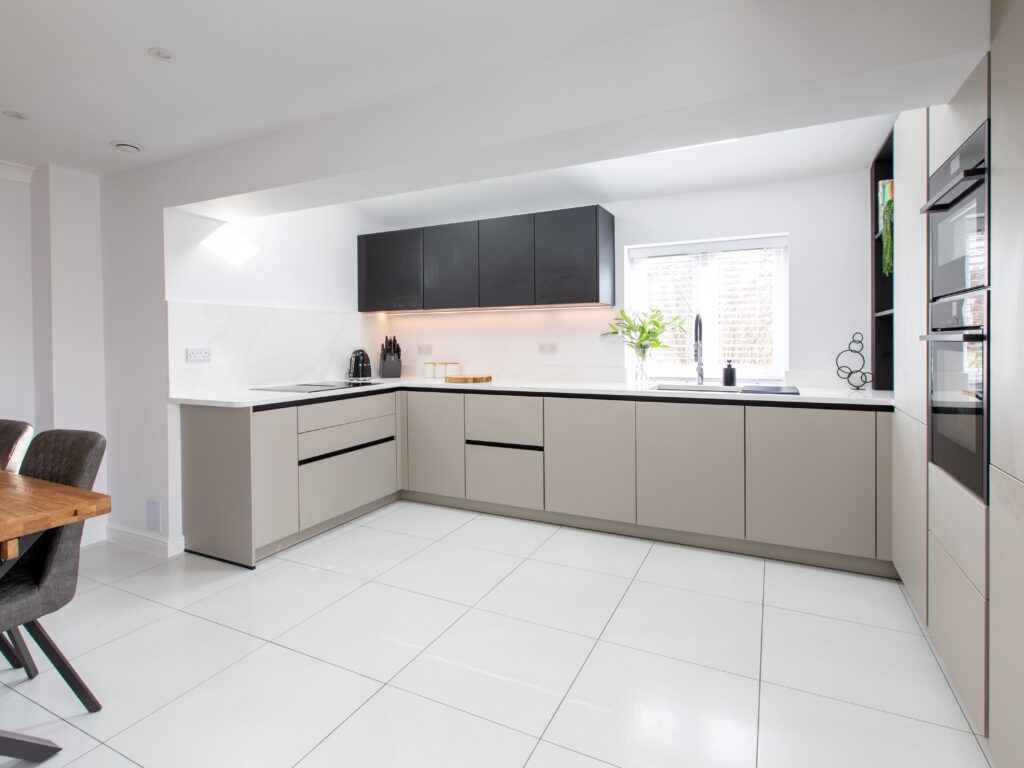
1. walls that aren’t square, and why 8mm can cost hundreds
Walls in UK homes almost never run perfectly square, and any deviation greater than 8–10mm across a run of units creates visible gaps, ill-fitting panels, or end conditions that no amount of mastic can properly disguise.
Older housing stock. including the detached and semi-detached properties common across Altrincham, Hale, and Timperley, frequently has walls that bow, lean, or meet at angles that look like 90° but measurably aren’t. For a run of kitchen units, even a 6–8mm deviation can cause a visible gap at the end panel or a waterfall effect where door fronts sit fractionally out of line with one another along the run.
If this isn’t caught at the design stage, the installer’s options on the day are limited: pack out the gap (which shows), cut panels on site (which takes time), or in worse cases re-lay the entire run from scratch. On a medium-sized kitchen, that rework can add £400–£800 in fitter time, and if worktops have already been templated, it means a new template visit and an extended fabrication lead time on top.
The fix is straightforward: walls are checked with a digital level and long straight-edge at the survey stage, not by eye on install day. Any deviation is designed out as a compensated panel, a scribed filler, a factory-trimmed end unit, so nothing is improvised under pressure when the cabinets are already on the drive. For more help with planning your spend, read How to Budget for a Kitchen Renovation Without Going Over.
2. ceilings that drop and floors that shift
A ceiling that drops 30mm across a kitchen run will prevent tall units from fitting; a floor that isn’t level means every base unit needs individual shimming, a slow, skilled job that isn’t always budgeted for in the original install quote.
Both problems are common and routinely missed. Many designers take a single ceiling height measurement at one end of the room. In older properties, ceilings can drop 25–40mm across five metres, which is fatal to a run of 2,150mm tall units if the design assumed 2,200mm clearance throughout. The units arrive. They don’t fit. Someone has to make a decision about what to do about it on the spot.
Floor variation has a ripple effect: every base unit must be individually levelled, plinths need cutting to fit, and if the variation exceeds what the plinth clip system allows, typically 40–70mm depending on the brand, custom shimming is needed. If the floor is also out of level relative to the wall, which happens in extensions where screed wasn’t applied consistently, the plinth-to-toe-kick reveal changes across the entire run.
Prevention requires multiple ceiling measurements across the full run, a floor level check at both ends and midpoint with a long spirit level, and all tolerances built into the technical drawing before any order is placed.
3. services not where the design expected them
Gas supplies, soil stacks, and electrical circuits that were assumed to be moveable, but weren’t confirmed with a qualified tradesperson, are responsible for some of the most disruptive mid-install surprises on kitchen projects.
This happens most on extension projects, where the kitchen was designed before services were finalised with the builder. But it also occurs on like-for-like replacements, where a client assumed a gas supply could shift a few hundred millimetres because it seemed logical, without first checking with a Gas Safe-registered engineer.
The specific risks carry real costs. A gas supply that can’t move because of building fabric forces the hob to relocate, which changes the worktop template, which affects every unit either side. A soil stack in an inconvenient corner occupies the only practical position for the end base unit. A buried electrical socket positioned 10mm too high creates a conflict with a drawer runner. Each sounds minor in isolation; each carries a tangible cost when it’s discovered on install day rather than during the survey.
Gas relocation is typically £300–£600 per metre via a Gas Safe engineer, plus Building Regulations notification. Electrical re-routing that triggers Part P adds an inspection and certification process taking several weeks. Neither is manageable mid-installation.
4. appliance specs that change between order and install
Appliances are frequently discontinued, superseded, or quietly revised between the time a kitchen is ordered and the time it’s installed, and if the new specification is even 10mm deeper or wider, it can affect the entire cabinet configuration around it.
German kitchen manufacturers work to tight tolerances. A housing unit designed for a 595mm-wide oven is not compatible with a 600mm-wide oven, those five millimetres are built into the design. When an appliance model changes, it often changes in ways the manufacturer doesn’t loudly advertise. Built-in fridge-freezers are particularly prone to quiet specification revisions; tall oven columns have also caught clients out mid-project.
The responsibility for re-checking this frequently falls between the client (who owns the appliance order) and the designer (who specified the housing unit). When neither party owns the task, it doesn’t get done.
Prevention is simple in principle: appliance specs should be re-confirmed within four weeks of the scheduled install date. This needs to be written into the project plan, who does it, by when, and what the process is if a change is found. A single housing unit re-order for a German kitchen typically costs £400–£900 and arrives on the standard 8–14 week lead time, leaving the install visibly incomplete in the interim.
5. the worktop template, where precision matters most
Worktop templating is the most precision-sensitive step in any kitchen installation. Errors, in measurement, in communication between designer and fabricator, or in unit position at the time of the template, regularly produce costly replacements.
For stone worktops (quartz, granite, engineered stone), fabrication starts from a physical template or digital scan of the kitchen post-install. Any discrepancy between the template and the actual fitted units means the slab comes back wrong. Common sources of error include units that shifted during install (even 3–4mm matters at the joint), a cut detail communicated by sketch rather than dimensioned drawing, or a sink cutout positioned relative to the wrong reference edge.
The financial stakes are meaningful. Replacing a section of 20mm quartz worktop runs from around £600 to over £2,000 depending on slab area, edge profile, and sink integration. More critically, fabrication adds another two to three weeks, meaning the kitchen remains unusable throughout.
Units must be fully level and fixed, not nearly fixed, before templating begins. All details must be confirmed in writing before the fabricator arrives: sink position, hob cutout dimensions, mitre joint locations, upstand heights. This is standard practice at Suga Küchen; it is not standard practice everywhere.
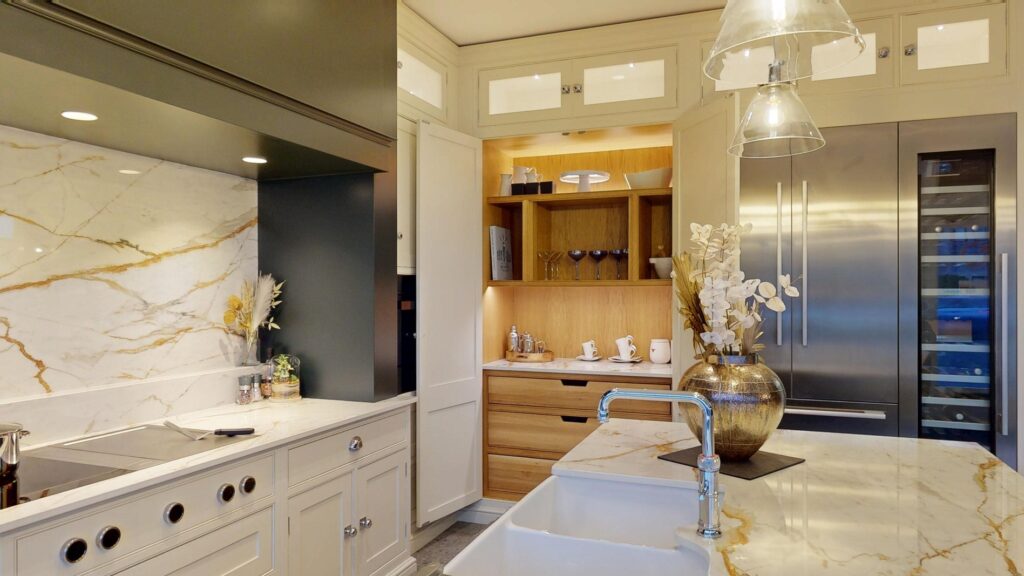
6. extraction venting with nowhere to go
Extraction routes that aren’t surveyed before a kitchen is designed regularly produce last-minute specification changes, and in some property types, there is simply no clean external venting route.
The assumption that extraction is straightforward, fit a hood, duct it outside, breaks down quickly in terraced houses, flats, or kitchens where the hob sits on an internal wall or island. A duct needing to travel six metres before exiting the building, or cross a steel beam in an extension, requires planning that can’t happen once the kitchen is ordered and the hood is specified.
Ductless (recirculating) extraction is sometimes the only viable option. Modern recirculating hoods with good charcoal filtration manage odours and grease adequately, but they do not remove humidity, a relevant factor in a family kitchen used daily for cooking. If a ceiling-mounted externally-ducted canopy was specified and that route proves impossible, the hood change may affect the unit configuration above it.
Extraction route confirmation should happen at the first design consultation, not after the order is placed. For extension projects with flat or vaulted roofs, this requires coordination with the architect and structural engineer before building regs are submitted.
7. snagging left undone, and questions to ask before you sign
The snagging stage is where small problems are supposed to be caught and corrected. When it’s rushed or skipped entirely, those small problems become the homeowner’s long-term irritation.
Snagging covers door alignment, soft-close adjustment, drawer runner engagement, filler strips, mastic sealing around the sink and splashback, and confirming every appliance powers up correctly. A door that hangs 3mm out of line, or a drawer that catches because the runner isn’t fully seated, degrades the daily experience of a kitchen that cost £30,000 or more, every single day.
Common snagging failures include: a mastic line applied badly and left; missing touch-up paint on cut panel edges; under-cabinet lighting installed but not connected; appliance warranty registration not passed to the client. The best installations include a formal snagging walk-through at handover, client present, issues logged, timescales agreed in writing, rather than an email list sent after the van has left.
To understand the benefits of a German kitchen in more detail, take a look at German vs British Kitchens: 7 Engineering Differences You Can See, Touch and Hear.
| Question | What a good answer looks like | Red flag |
|---|---|---|
| Who conducts the snagging walk-through — fitter or designer? | Designer or project lead attends with the client | “The fitter will sort anything outstanding” |
| Is the sign-off documented in writing? | Written snag list with agreed resolution dates | Verbal agreement only |
| How quickly do you respond to post-install issues? | Named contact; 24–48 hour response commitment | No specific SLA given |
| What if a snag item needs a part re-ordered? | Direct route to manufacturer; client kept updated | “It’ll take as long as it takes” |
| Do you carry out a 12-month review? | Yes — hinge and runner check at 12 months as standard | No follow-up process |
| Who is my single point of contact after handover? | Named person with a direct number | General enquiries email only |
| Are appliance registrations completed on my behalf? | Yes, or clear handover instructions provided | “You’ll need to do that yourself” |
What our designers would say
The problems I see most often aren’t about workmanship on install day, they’re about information that wasn’t gathered or confirmed at the right point in the process. A wall that’s out of square isn’t a crisis if we know about it during design. It becomes a crisis if the installer finds it on the morning the cabinets are due in. At Suga Küchen, the pre-install site survey isn’t a formality, it’s the moment every outstanding question gets answered before anything is ordered or built. In fifteen years of fitted kitchen projects, the ones that go smoothly share one thing: everyone involved knew the site before they started.
Danil Sugakov, Director, Suga Küchen
common mistakes to avoid
- Assuming walls are square without measuring. Visual inspection is not enough, a well-plastered wall can bow by 10–15mm across a standard kitchen run. Use a long straight-edge and digital level at site survey, not on install day.
- Locking in appliance specifications and never re-checking. Appliance ranges change continuously. Re-confirm all specifications against cabinet dimensions within four weeks of the install date, and name a person responsible for doing so in the project plan.
- Templating worktops before units are fully fixed. Any unit movement after templating, even 3mm, risks a misfit on the slab. Every unit should be plumb, level, and wall-fixed before the fabricator arrives.
- Not confirming the extraction route before ordering the kitchen. A duct that can’t exit the building means a hood change that may cascade into a unit configuration change. Confirm this at the first design meeting.
- Accepting a verbal snagging sign-off. A spoken “all done” is not a record. Insist on a written snag list, agreed resolution dates, and a named contact before the install team leaves.
- Bringing the kitchen designer in after the architect has drawn the services layout. Particularly on extension projects, services placed in the wrong position after the kitchen design is fixed can be expensive or structurally impossible to move.
frequently asked questions
How often do kitchen installations go wrong?
Industry data on kitchen installation failure rates isn’t published centrally, but the Kitchen Bathroom Bedroom Specialists Association (KBSA) notes that poor site surveys and inadequate pre-install planning are among the most common causes of customer complaints. Most problems are low-level, alignment issues, snagging items, minor service conflicts, but a small proportion involve costly re-orders or rework that delays completion by several weeks.
What’s the most common kitchen installation mistake?
In our experience, the single most frequent problem is services: gas, water, or electrics – not being in the position the design assumed, particularly on extension projects where the kitchen layout was drawn up before services were confirmed with the builder. This produces a cascade: move the hob, retemplate the worktop, re-order the affected unit. A confirmed service survey at the start of the project avoids this chain entirely.
Who’s responsible if a kitchen installation goes wrong?
Responsibility depends on the cause. Under the Consumer Rights Act 2015, your contract is with the retailer, who remains responsible regardless of whether installation was carried out by employed or sub-contracted fitters. If the error lies in the design or specification, the retailer carries liability. If it lies in the installation itself, the installer does, but you pursue this through the retailer, not the individual fitter.
Can I take legal action if a kitchen is fitted badly?
Yes. Under the Consumer Rights Act 2015, goods and services must be fit for purpose and installed with reasonable care and skill. If a kitchen fails that standard, you’re entitled to a repair, replacement, or partial refund depending on the nature and timing of the defect. Keep written records of all communication and a photographic record of any defects from the point you first notice them.
How do I check my kitchen installation is complete before signing off?
Walk through methodically: open every door and drawer and check for smooth, consistent movement; verify that all door fronts hang level in line with their neighbours; confirm every appliance powers up; check mastic sealing around the sink and any wet areas; confirm all plinth clips are engaged; verify that lighting is connected and working; and ensure all appliance manuals and warranty documentation have been handed over. Anything outstanding goes on a written snag list before you sign.
Should I be present during my kitchen installation?
You don’t need to be there throughout, but you should be available by phone during the first day and at the point of worktop templating. Being present at the snagging walk-through is strongly recommended, minor alignment adjustments are most efficiently dealt with at that point, and it gives you the opportunity to confirm every item is resolved before the install team leaves. Getting someone back weeks later for small outstanding items is significantly harder than addressing them on the day.
Written by Danil Sugakov, Director, Suga Küchen.