 0161 962 7261
german vs british kitchens: 7 engineering differences you can see, touch and hear
Quick answer: German kitchens outperform British budget alternatives on seven measurable points: dowel-joined carcasses, 19mm board thickness, Blum or Hettich hinges, integrated soft-close drawer runners, laser-applied edge banding, tighter manufacturing tolerances, and precisely fitted handleless rails. Each difference is detectable in a showroom, and each shapes how the kitchen performs in year ten and beyond.
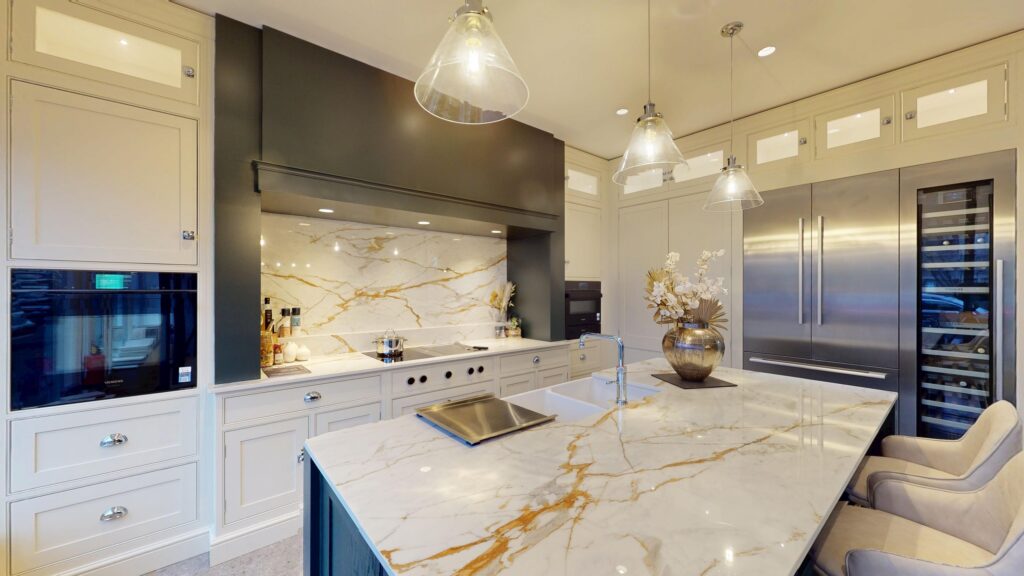
When two kitchens look broadly similar in a showroom, the price gap can be hard to explain. One costs £25,000. The other costs £45,000. Both have white handleless doors and a familiar galley layout. So where does the extra money go?
The answer lies mostly in engineering you cannot see at a glance, but can detect if you know what to look for. This article runs through seven specific construction differences between German kitchens, such as those by Schüller, and budget British alternatives. Each one is measurable, demonstrable in a showroom, and consequential over ten or more years of daily use. It sits alongside our broader guide to whether German kitchens are worth it for UK homeowners. Visit our Altrincham kitchen showroom to experience the difference in quality, engineering, and design detail for yourself.
1. cabinet box construction, dowel-built vs cam-lock
The way a carcass is joined determines its long-term rigidity. German manufacturers use precision-drilled wooden dowels with high-strength adhesive, set at regular intervals to spread load across the full panel joint. The result is a carcass that behaves like a single unit under weight and movement.
Budget British cabinets, and some mid-range options, rely on cam-lock fittings: bolt-and-cam mechanisms designed for flat-pack self-assembly. Cam-locks work initially, but they are built for speed of assembly, not longevity. Under repeated loading they allow micro-movement at the joint. Over five to ten years in a busy kitchen, that movement accumulates into visible racking and misalignment.
What to check in a showroom: locate the interior corner joint of an open carcass and apply slight lateral pressure. A dowel-built cabinet will not flex. A cam-lock cabinet typically will.
2. carcass thickness: 19mm vs 16mm board
German kitchen carcasses are typically built from 19mm board. Many budget British kitchens use 16mm – a 3mm saving per panel that multiplies across every cabinet in a run. The difference in rigidity is significant: 19mm resists racking, bowing under shelf load, and door-hinge pull-through substantially better.
According to FIRA International, panel thickness is one of the primary variables in long-term carcass performance under sustained load. A base unit under a worktop carries the weight of the surface itself, the appliance above or within it, and daily cooking loads for potentially two decades. The margin for error in a 16mm carcass is thinner, quite literally.
What to listen for: knock on the side panel of a base cabinet. A 19mm board gives a lower, denser note. A 16mm panel sounds noticeably more hollow.
3. hinge brand – blum or hettich vs generic
Hinges are among the most-used mechanical components in any kitchen. A busy household opens and closes cabinet doors thousands of times each year. Over a decade, a standard hinge may complete 50,000–100,000 cycles.
Blum and Hettich: the two dominant German hinge manufacturers – engineer their products to tested cycle counts above 200,000 and include integrated soft-close as standard. They also offer six-way adjustment, so a door that drifts slightly after installation can be realigned without tools or replacement parts.
Generic hinges found in budget kitchens are typically rated to far lower cycles, lack reliable soft-close, and cannot be adjusted beyond basic positioning. When a door begins to sag, the only practical fix is replacement.
What to check: open a cabinet door to 90 degrees and release it. A Blum or Hettich hinge holds position. A generic hinge tends to drift.
4. drawer runner soft-close – integrated vs add-on
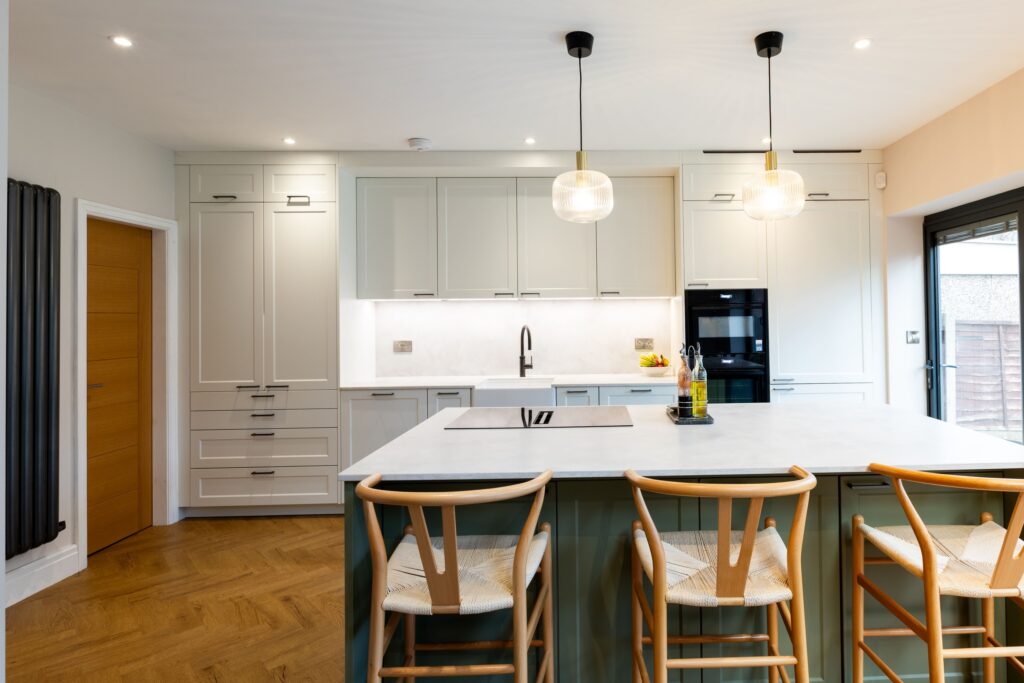
German kitchens use full-extension, integrated soft-close drawer runners, typically Blum Tandembox or equivalent. The drawer travels to the full depth of the cabinet, closes silently under controlled resistance, and carries a rated load of 30–70kg depending on the specification.
Budget runners typically offer partial extension (around 75% of drawer depth), rely on an optional add-on dampener for soft-close, and carry lower rated loads. The result is a drawer that either falls short before reaching the back, slams when pushed, or fails under load within a few years rather than lasting decades.
What to feel: extend a drawer fully. It should travel close to the cabinet’s full depth and return gently under its own weight when pushed lightly from the front.
5. edge banding, laser vs hot-melt adhesive
Every exposed board edge in a kitchen, every side panel, shelf edge and door perimeter, is covered by a thin strip of banding material. How that strip is applied determines how long it stays in place.
German manufacturers use laser edge banding: a process where heat from a laser fuses a co-polymer backing directly into the board surface, leaving no separate adhesive line. The result is a near-invisible joint that resists moisture penetration, particularly near a sink or dishwasher.
Budget kitchens use hot-melt adhesive. Over time, heat and steam compromise the glue line. The edge begins to lift at corners. Once moisture penetrates behind the banding, the board swells, and once swelling starts, it does not reverse.
What to feel: run your fingernail along the edge of a door near a corner. If you can detect a glue seam, it is hot-melt. If the edge feels continuous with the surface, it is likely laser-applied.
6. tolerance precision, ±0.5mm vs ±2mm
German kitchen manufacturing operates to tolerances of approximately ±0.5mm. British mass-market production typically runs to ±1.5–2mm. In a single cabinet the gap is invisible. Across a full run of ten or twelve units, particularly in a galley layout, cumulative variation can exceed 15mm. That has to go somewhere.
In practice it shows up as uneven reveals between adjacent doors, end-panel alignment issues, and filler strips that need to be wider than planned. In a German kitchen, the precision allows joints to meet cleanly and panels to align without improvised packing.
7. handleless rail fit – designed in vs added on
Handleless kitchens depend on a precisely made aluminium rail that runs the full width of the door and functions both as the grip and as an alignment feature. In German kitchens, the rail profile and the door edge are manufactured to the same tolerance; the rail sits flush, the reveal is even, and the geometry holds over years of use.
In cheaper alternatives, the rail is often a standard profile applied to a door not specifically designed to receive it. The fit is approximate. Over time the rail can loosen, twist marginally, or show uneven gaps, and in a handleless kitchen, any misalignment is immediately visible across the full face of the run.
“Most people notice the engineering differences within the first six months, usually through something small. A drawer that’s slightly reluctant to close. A door that drifts by a millimetre. An edge that starts lifting near the dishwasher. These aren’t just aesthetic niggles; they’re signals that the construction was working to tighter margins than it needed to. German manufacturers don’t build to a minimum. They build to a specification that means the kitchen is still performing as intended at year fifteen, with the same quiet confidence it had on day one.”
— Danil Sugakov, Director, Suga Küchen
at a glance: german vs budget british construction
| Feature | German (e.g. Schüller) | Budget British / Import | 10-Year Impact |
|---|---|---|---|
| Carcass joint | Dowel + adhesive | Cam-lock | Rigidity vs racking |
| Board thickness | 19mm standard | 16mm common | Bowing and sag risk |
| Hinges | Blum / Hettich (200k+ cycles) | Generic (≤50k cycles) | Door sag and replacement |
| Drawer runners | Full-ext. integrated soft-close | Partial-ext. add-on dampener | Slamming and early failure |
| Edge banding | Laser-fused (no glue line) | Hot-melt adhesive | Moisture ingress, board swell |
| Tolerance | ±0.5mm | ±1.5–2mm | Cumulative reveal misalignment |
| Handleless rail | Designed to door profile | Standard profile added on | Loosening and visible gaps |
common mistakes to avoid
Judging construction quality by door finish alone – the engineering is in the carcass, not the surface.
Assuming all soft-close mechanisms are equivalent, integrated runners and clip-on dampeners age at very different rates.
Ignoring edge banding when inspecting a showroom kitchen, run your fingers along the edges, not just the faces.
Comparing hinge quantities rather than hinge brands, one Blum hinge outlasts several generic alternatives.
Overlooking the 3mm carcass-thickness difference because it sounds trivial, it multiplies across every cabinet in the room.
Assuming a handleless kitchen is purely an aesthetic choice, the rail fit is a functional structural element that shows its quality over years.
Book a design call with our team to discuss your project, ask questions, and get practical advice tailored to your space and budget.
frequently asked questions
What are dowel-built cabinets?
A dowel-built cabinet uses cylindrical wooden pegs in pre-drilled, precisely spaced holes to join panels together, typically in combination with wood glue. The joint is rigid, load-bearing, and permanent once set. It contrasts with cam-lock assembly, which uses a bolt-and-cam mechanism, designed for flat-pack speed but producing less structural rigidity under sustained load over time.
Are Blum hinges worth paying for?
Yes, over the life of a kitchen they represent good value. Blum hinges are engineered to exceed 200,000 open-close cycles, include precise six-way adjustment mechanisms, and can be repaired or recalibrated rather than replaced. A generic hinge failing at 50,000 cycles in a busy household will need replacing within five years. Blum UK spares are also widely available, which matters when something needs attention a decade in.
Do all German kitchens use 19mm carcasses?
The majority of established German manufacturers, including Schüller and next125, use 19mm board as standard across their carcass construction. Some ranges at the lower end of the market may use 16mm in specific applications, so it is worth confirming per range rather than assuming. At Suga Küchen, 19mm is the standard across every range we supply.
How do I tell quality just by touch in a showroom?
Focus on four checks: press a cabinet side panel for flex; pull a drawer fully open and assess its travel and return; run a finger along edge banding near a corner joint; and open a door to 90 degrees then release it to see whether it holds position. These four actions take under two minutes and reveal more about construction quality than any brochure specification.
Why do drawers slam in cheap kitchens?
Slamming results from runner mechanisms that either lack integrated damping entirely or rely on a clip-on dampener that has worked loose over time. Budget runners close under gravity alone; the speed at the end of travel converts directly into noise and impact. Integrated soft-close mechanisms use hydraulic resistance to decelerate the drawer through the final 30–50mm of travel, eliminating both the sound and the mechanical wear that slamming causes.
Wherever you are in your kitchen plans, a short conversation with one of our designers can save weeks of second-guessing. Chat with a designer, no pressure, no sales pitch, just practical guidance grounded in real installation experience.
Written by Danil Sugakov, Director, Suga Küchen. Last updated 7 May 2026.