 0161 962 7261
kitchen chain, independent or bespoke maker, which suits your home?
Quick answer: For most UK homeowners with budgets of £18,000–£55,000, an independent kitchen showroom offers the best combination of design quality, product range and continuity of service. Kitchen chains suit simpler briefs and tighter budgets (typically under £18,000). Bespoke handmade kitchens suit homeowners with budgets above £50,000 renovating significant or architecturally distinctive properties where the kitchen is a defining design statement.
Walk into most high-street areas and you’ll find three distinct types of kitchen business competing for the same renovation budget. Kitchen chains: Wren, Magnet, Howdens, Wickes, B&Q – compete on price and speed. Independent showrooms, like Suga Küchen in Altrincham, compete on design depth and long-term service. Bespoke handmade makers: names like Tom Howley, Martin Moore and Plain English – compete on craft and exclusivity. Each model serves a different kind of homeowner. Choosing the right one before you start planning saves months of frustration and, in many cases, the cost of getting it wrong.
This guide runs through all three tiers honestly. No defensive positioning, just a practical comparison of what each model actually provides – and the circumstances in which each one makes sense.
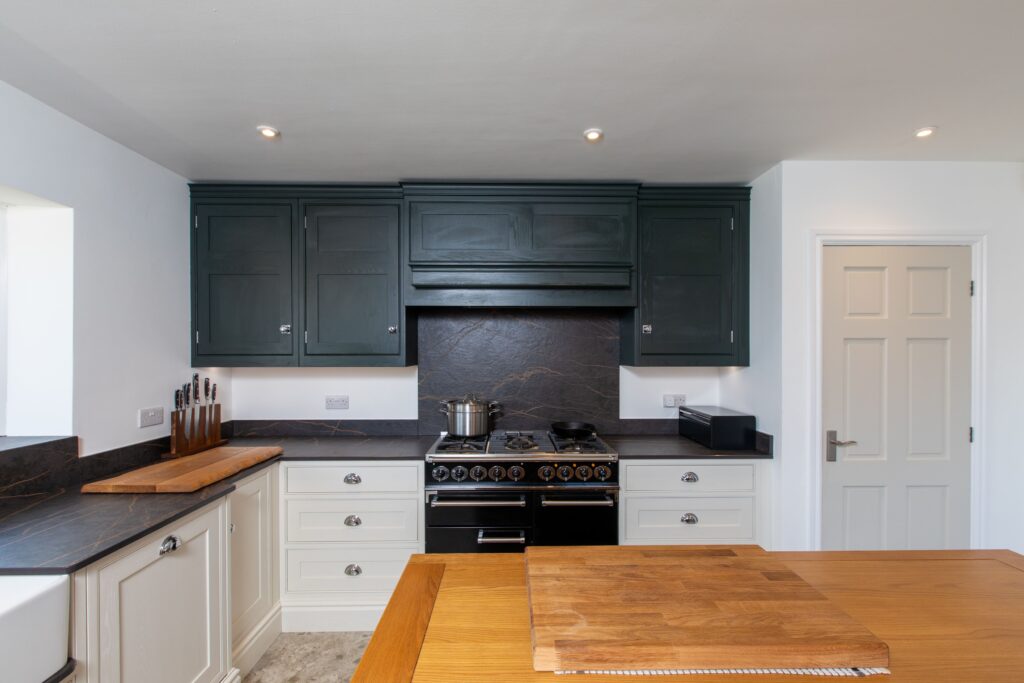
what separates the three tiers of kitchen supplier
The most useful way to understand the three tiers isn’t quality (though quality does vary) – it’s about how the business model is structured. Chains are built around volume: standardised products, centralised design software and national scale. Their model requires high throughput, which shapes every part of the experience. Independents are built around the individual project: a named designer works with you from the first conversation to post-installation sign-off, with access to a curated range of made-to-order cabinetry. Bespoke makers are built around the object itself: every component is made from scratch, often by hand, in UK workshops.
Those structural differences cascade into everything: lead times, design quality, fitting continuity and what happens when something needs attention in year three. Understanding the model helps you choose the right tier before you start spending time in showrooms.
kitchen chains, what you get, and who they suit best
The major chains operate a high-volume model. Products are engineered for efficient production and rapid delivery: flat-pack, cam-lock construction with standard carcass sizes and a well-defined catalogue of door styles, finishes and accessories. Entry price for a complete chain kitchen: supply, fitting and appliances – typically runs from £8,000 to £25,000 for a mid-size space, rising to around £30,000 for larger rooms with a higher specification.
Design is usually provided by an in-store consultant working with the chain’s own planning software. The quality of that service varies widely between individual consultants and between branches. Some consultants are genuinely skilled; many are competent but under time pressure, serving multiple customers in short appointment slots. The model doesn’t easily accommodate iterative, site-specific design, if your room is non-standard, a chain consultant may simply fit the catalogue to the space rather than develop a layout that suits the way you use it.
Fitting is almost always sub-contracted. The chain takes the order and passes the installation to a self-employed fitter or a small fitting company from an approved network. The person who designed your kitchen is rarely the person fitting it, and the connection between the two is often thin. Aftercare varies significantly between chains – and between branches of the same chain.
Who chains suit: Homeowners with a straightforward layout, a firm budget under £18,000, a clear idea of what they want, and the confidence to manage the project themselves. Also a practical option for buy-to-let properties, second homes and rental kitchens where longevity and design originality are lower priorities.
Where chains fall short: Complex or non-standard spaces, extension projects, design-led briefs, and anyone who wants a single consistent point of contact from design to installation and beyond. Aftercare once installation is signed off tends to be inconsistent.
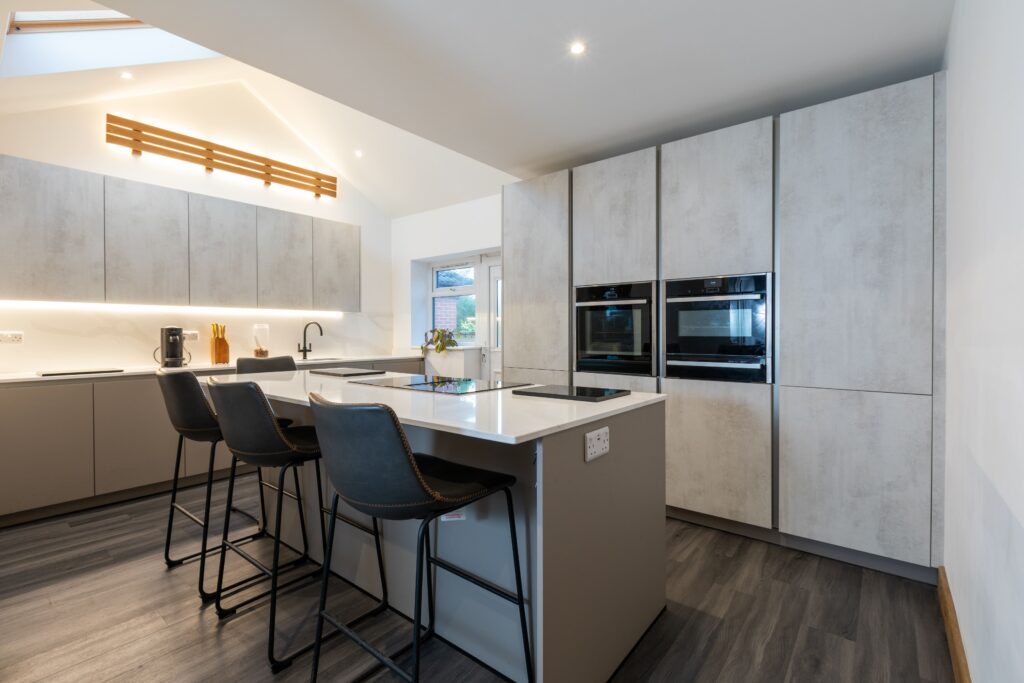
independent kitchen showrooms, where the design goes deeper
Independent showrooms are structured differently by design. A customer works with one named designer from the first conversation: covering budget, lifestyle brief and spatial analysis – through to delivery, installation and the snagging visit. That continuity changes what’s possible: a designer who knows your kitchen intimately can catch problems before they become expensive, make site-specific decisions with confidence, and take responsibility for the outcome rather than handing it off at each stage.
The product range is typically built around two or three carefully selected German or European manufacturers. At Suga Küchen, that means Schüller, Keller Kitchens and next125 – all made to order, with a far wider matrix of carcass sizes, finishes, handle systems and interior accessories than any chain can match from standard stock. Because the cabinetry is manufactured to your exact specification in Germany, lead times are longer: typically 12–18 weeks from order to installation. That wait translates directly into a better-fitting, better-finishing kitchen.
Price range: broadly £18,000–£55,000 for supply and installation, depending on room size, specification level, appliances and any structural or services work required. The entry point is higher than chains. The top end sits comfortably below bespoke handmade. Fitting is typically handled by employed fitters or long-standing trade partners who work directly with the designer – the decision loop when something needs adjusting on site is short.
Who independents suit: Homeowners with a design-led brief, a non-standard or complex space, a total budget from around £18,000 upward, and a preference for working with one person rather than a process. Particularly well-suited to extension projects, where kitchen and building design need coordinating from the earliest planning stage.
Where independents fall short: If your brief is genuinely simple and your budget is firmly under £15,000, you are unlikely to find the product range or the commercial model that suits at an independent. Most independents also don’t hold flat-pack stock, so a very fast turnaround isn’t usually feasible.
bespoke handmade kitchens – the top tier, and its trade-offs
Bespoke handmade makers occupy a different world. Companies such as Tom Howley, Martin Moore and Plain English build their cabinetry from solid timber or high-grade painted MDF, in UK workshops, to the exact dimensions of your room. Finishes are mixed and applied in-house. The design process is extensive: multiple site visits, hand-drawn or architect-quality layouts, and in many cases close collaboration with the homeowner’s wider design team.
Entry price for a bespoke handmade kitchen typically starts at £50,000–£70,000 for a medium-size room. Larger or more complex kitchens reach £100,000 and above. Lead times run from 18 to 26 weeks. The finished result is exceptional – a kitchen that is physically unique, built from materials of outstanding quality, with a precision and consistency of finish that no production kitchen can replicate.
The trade-offs deserve honest attention. Solid timber moves with changes in humidity and temperature. Painted finishes require careful maintenance and eventual touching-up. Sourcing matched replacement components in ten or fifteen years takes effort. None of this is a reason to avoid bespoke, but it is a reason to be clear-eyed about what you are committing to, and whether the context justifies it.
Who bespoke suits: Homeowners with budgets above £50,000 renovating a significant or architecturally distinctive property, typically working with an architect, where the kitchen is intended as a design statement and a long-term investment in the building. Also a natural fit for period homes where a handmade, painted kitchen is the visually appropriate choice.
Where bespoke falls short: Most family homes in Altrincham, Hale, Wilmslow and the wider Cheshire area are not the right context for a £70,000 handmade kitchen. The investment is real and the quality is genuine, but for a typical £450,000–£750,000 semi or detached, a well-specified independent kitchen at £25,000–£40,000 will perform as well in daily use and represent a more proportionate allocation of renovation budget.
side-by-side comparison: chains, independents and bespoke makers
| Kitchen chains | Independent showrooms | Bespoke handmade | |
|---|---|---|---|
| Typical price (supply + fit) | £8,000–£25,000 | £18,000–£55,000 | £50,000–£150,000+ |
| Lead time | 4–8 weeks | 12–18 weeks | 18–26 weeks |
| Design service | In-store consultant, software-led | Named designer, full process start to finish | Senior designer + architect collaboration |
| Cabinet construction | Flat-pack, cam-lock, standard sizes | Made to order, German precision, 19mm carcass | Solid timber or high-grade MDF, hand-built |
| Fitting model | Sub-contracted, variable quality | Employed or trusted trade partners | Workshop-nominated specialist fitters |
| Customisation | Catalogue range only | High — hundreds of finishes, sizes and accessories | Unlimited — made entirely to specification |
| Aftercare | Varies by branch, often limited | Consistent, direct, same designer and team | Dedicated team, but may carry a cost |
| Best for | Simple briefs, confident self-managers, budget-led | Design-led briefs, complex spaces, £18k–£55k | Significant properties, £50k+ budgets, design statements |
how to work out which tier is right for your home
The decision is less about aspiration and more about circumstances. Three questions do most of the work.
What is your realistic total budget, including appliances, fitting, removal and contingency? If you are working under £15,000, chains are your realistic starting point. Between £18,000 and £55,000, an independent showroom gives you the best combination of design quality, product range and service continuity. Above £55,000, and particularly if you are renovating a significant property, bespoke becomes worth serious consideration.
How complex is your space? A standard rectangular room with a straightforward layout is something both chains and independents can handle well. A non-standard room, a kitchen that’s part of an extension, a space with walls out of square, low ceilings or restricted service routes, these demand fitter-led technical thinking that most chains are not structured to provide. At that point, the cost of choosing the wrong tier shows up on site, not in the showroom.
How much do you want to be involved in the design process? If you have a clear brief and want efficient execution, a chain can work well for you. If you want someone to develop your brief with you, to challenge a layout that won’t work in practice, to understand how you actually cook before drawing a single cabinet line, you need a designer who has the time and technical framework to do that. That’s the structure of a good independent, not a chain.
The Suga Küchen kitchen showroom in Altrincham is a useful starting point if you are in the £18,000–£55,000 range and want to understand what’s possible before you commit to any tier. The KBSA also maintains a directory of vetted independent specialists if you are looking beyond Altrincham and Cheshire.
“The question we hear most often is: why not just go to Wren and save the difference? It’s completely fair to ask. The honest answer is that chains and independents are solving different problems. A chain is optimised to process a high volume of relatively straightforward projects efficiently. We are set up for the harder briefs, the awkward shapes, the extension in progress, the family who needs someone to think through how they actually use the room before a single cabinet line gets drawn. If your kitchen is simple and your brief is clear, a chain may be exactly right for you. If it isn’t, the cost of getting it wrong at that stage tends to be considerably higher than the price difference between tiers.” – Cassandra Wilkinson-Leonard, Senior Designer, Suga Küchen
common mistakes to avoid
- Comparing quotes across tiers without accounting for what’s included. A chain quote rarely includes fitting, appliances or removal of the existing kitchen on the same basis as an independent’s all-in price. Always establish what is and isn’t in each quote before drawing a comparison.
- Choosing on showroom appearance alone. A beautifully dressed display area does not guarantee product or service quality. Ask every showroom to show you a kitchen they fitted two or more years ago – preferably one you can visit or whose owner you can speak to.
- Assuming “bespoke” means better for your home. The word is used loosely across the industry. A well-specified independent kitchen built from German-manufactured cabinetry will outlast and outperform a handmade kitchen that’s disproportionate to the property it’s in. Match the tier to the context.
- Under-valuing aftercare at the buying stage. Chains and independents differ significantly in what happens when a hinge needs adjusting in year two or a door finish needs matching in year seven. Understand the aftercare model before you sign, not after.
- Not establishing who actually fits the kitchen. The gap between chain design and chain installation is where most problems originate. Ask directly whether fitters are employed or sub-contracted – and what the escalation route is if something goes wrong on site.
- Anchoring to a brand seen in a magazine or on social media without checking whether it suits your space, budget or lifestyle. Visual inspiration is useful; treating it as a brief is not. Start with how you use your kitchen, not with how you want it to look.
frequently asked questions
Are kitchen chains worse quality than independents?
Not always – but the product range is narrower and the service model is less consistent. Chains use flat-pack, cam-lock construction with standard carcass sizes; good independents typically specify made-to-order German cabinetry with tighter tolerances and premium hardware (Blum hinges, Hettich runners). The quality gap is most visible at the seven-to-ten-year mark, when hinges loosen, drawer runners fail and edge banding begins to lift on cheaper builds.
Why are bespoke kitchens so expensive?
Bespoke kitchens are hand-built in UK workshops from solid timber or high-grade painted MDF, made to the exact dimensions of your room and finished individually. The process is labour-intensive by design. Lead times of 18–26 weeks reflect that. You are paying for skilled craft and complete customisation – which is both the source of the quality and the reason for the price.
Can independents match chain prices?
Rarely on a like-for-like basis. An independent’s made-to-order German cabinetry, full design service and trusted fitting team carries a different cost base to a chain’s flat-pack range and sub-contracted installation. Where independents offer genuine value is in the £20,000–£45,000 range: a kitchen that will perform meaningfully better over 15–20 years than a chain equivalent at £15,000–£22,000.
Do chains do good design?
Some in-store chain consultants are talented designers. The structural constraint is time: chain consultants typically work through a high volume of customers with short appointment slots. The model doesn’t accommodate the kind of iterative, site-specific brief development that produces well-considered design. For straightforward rooms it can work; for complex or design-led projects it usually doesn’t.
Who fits the kitchen – the chain, or someone else?
Chains almost always sub-contract fitting to self-employed fitters or small fitting companies from an approved network. Quality varies. Independents typically use either employed fitters or consistent trade partners who have worked with the design team before. That continuity is where installation problems get caught before they become expensive – the designer and the fitter are in direct communication.
What aftercare do you get from each tier?
Chain aftercare varies by branch. Stock availability of your specific door and finish may be limited after a few years, and response times depend on individual staff. Independents, good ones, maintain a direct relationship post-installation: year-one adjustments, a snagging route back to the designer, and continuity for longer-term needs. Bespoke makers usually have dedicated aftercare teams, though some services carry an additional charge.
Wherever you are in your kitchen plans, a short conversation with one of our designers can save weeks of second-guessing. Chat with a designer – no pressure, no sales pitch, just practical guidance grounded in real installation experience.
Written by Cassandra Wilkinson-Leonard, Senior Designer, Suga Küchen.