 0161 962 7261
how to design a kitchen that works for the way you actually live
Quick answer: the best kitchen layout is not the one that looks good in a brochure, it is the one built around your daily habits, cooking patterns and household traffic. Understanding your lifestyle archetype first, whether you are a family cook, an entertainer, a home-office professional or an empty-nester, shapes every layout decision from zone placement to walkway width, long before a single dimension is drawn.
If you have spent time researching kitchen layouts, you will have encountered the same repeating images: spacious islands, natural light flooding through bifold doors, surfaces clear of everything except a single bowl of lemons. What those images do not tell you is whether the layout suits someone who cooks from scratch every evening while two children do homework at the island, or whether it works for a couple who host dinner parties monthly and need a clear, unobstructed route from the hob to the dining table.
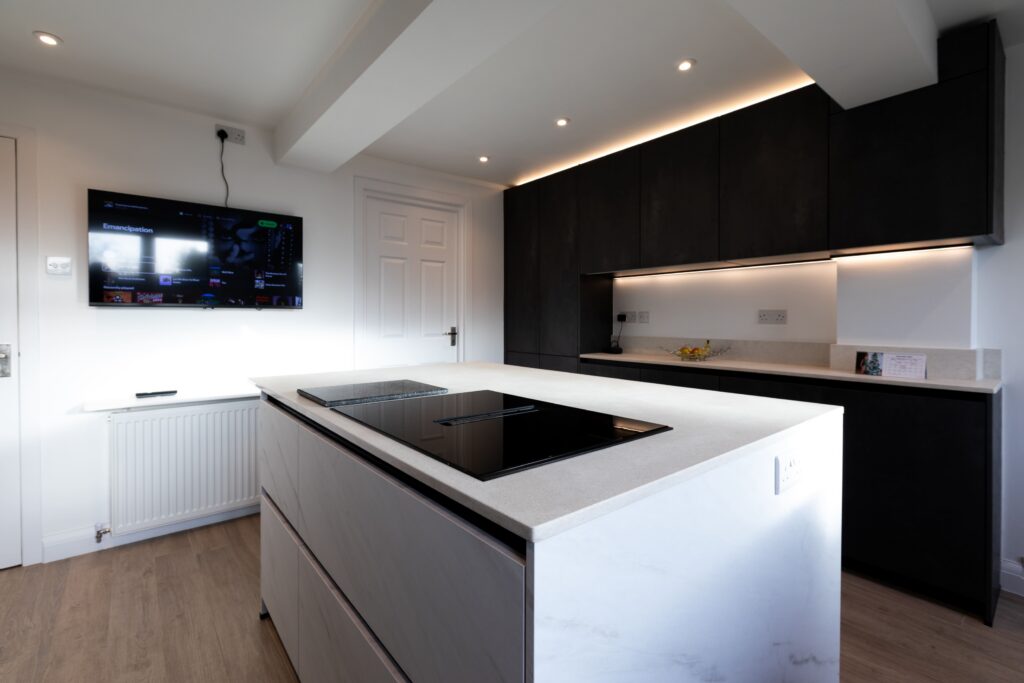
Kitchen layout design is, at its core, a problem of behaviour. The way you actually move through the space on a Tuesday evening, what you reach for, where you stand, how many people are in the room simultaneously, matters far more to long-term satisfaction than any aesthetic trend. This guide covers how to approach layout design from the way you live outwards, using four household archetypes, a five-zone planning model, and a simple paper-test method you can do before any plans are finalised. Visit our showroom to see our kitchens in person and get a real feel for materials, finishes and layouts.
start with how you use the kitchen, not how you would like it to look
The most useful thing you can do before opening a design brochure is spend a week observing how you actually use your current kitchen, not the idealised version, but the real one. Where do bags land when you come home? Which worktop corner becomes a dumping ground by Wednesday? Do household members converge around the hob or naturally spread out?
These observations are more valuable than any mood board. They tell you where friction lives in your existing space, and by extension where your new layout needs to solve problems. A practical exercise is to trace your own “desire lines”, the four or five most-travelled routes through the kitchen during a busy evening. If your current setup forces you to cross the cooking zone to reach the bin, or to walk past the hob to get to the fridge, that is friction worth designing out.
At Suga Küchen, designers ask new clients to complete a brief lifestyle audit before the first design session. Not because the answers dictate a single layout outcome, but because they surface the constraints that genuinely matter. A family with primary-school-age children has entirely different sight-line priorities than a professional couple who cook occasionally and entertain often. Neither is a harder brief, they just need a different starting point. Book a design appointment to explore ideas with one of our designers and start shaping a kitchen that works for you.
four archetypes, and how each changes the layout
Most households fall into one of four broad patterns when it comes to kitchen use. Identifying which archetype best describes your household helps narrow layout decisions at every stage of the design process.
The cook-everything family. Three or more people regularly active in the kitchen throughout the day: breakfast, packed lunches, after-school snacks, dinner. This household needs the maximum continuous worktop run, a large single or double sink, and a layout that allows two adults to cook in parallel without crossing each other’s path. Islands work well here if the room can support 1 metre of clear walkway on all sides; a peninsula is often more practical and better value where space is tighter. Tall storage for everyday items, accessible without bending, is worth building in early.
The entertainer. Regular dinner parties, weekend lunches, informal gatherings where food is central. The key layout concern is the relationship between the kitchen and the social space: sightlines, flow, and the ability to cook while holding a conversation. Open-plan is almost always right for this archetype. The hob benefits from being oriented to face the room rather than a wall. Storage for glassware and serving pieces needs to be accessible without cutting through the cooking zone. A second prep surface near an island keeps guests at a safe, comfortable distance from the cooking activity.
The work-from-home professional. One or two adults using the kitchen across the full working day, morning coffee, lunch, afternoon coffee, evening meal. The kitchen sees four or five distinct sessions daily rather than a concentrated evening rush. This archetype benefits from good ambient lighting throughout the day (not only task lighting above the worktop), a calm, uncluttered layout that resets easily between uses, and intuitive placement of everyday items that reduces low-level friction across many visits per day.
The empty-nester or downsizer. Two people with more time, more considered cooking, and a different relationship with kitchen space, less focused on volume, more on quality and ergonomic comfort. The emphasis shifts to unit heights and drawer accessibility, specific cook’s features such as dedicated spice storage and good appliance positioning, and a kitchen that no longer needs to double as a homework zone. People moving from larger family homes sometimes over-specify on size and under-specify on quality of specification.
| Archetype | Primary layout priority | Layouts that work well |
|---|---|---|
| Cook-everything family | Long worktop run, large sink, parallel cooking | U-shape, L-shape with peninsula |
| Entertainer | Hob facing room, prep-to-table flow, open plan | L-shape with island, open-plan run |
| WFH professional | Calm layout, clearly separated zones, natural light | Galley, L-shape |
| Empty-nester / downsizer | Ergonomics, quality specification, reduced volume | L-shape, compact U-shape |
why the kitchen triangle no longer works for most homes
The kitchen work triangle, the principle that fridge, sink and hob should form a triangle with specific distances between them, was developed in the 1940s by researchers at the University of Illinois. It was designed for a single cook in an enclosed kitchen working with a limited range of appliances. For its time, it was a genuinely useful planning model.
Modern kitchen use has moved well beyond it. Most households now combine a tall fridge-freezer, a separate wine or drinks fridge, a second prep sink at an island, a coffee machine, a microwave at a different height to the oven, and a steam or combination oven alongside the main cooking appliance. The triangle cannot account for this kind of equipment spread. More critically, it does not account for multiple cooks, one of the most common realities in today’s family kitchens.
The KBSA and most practitioner-led kitchen studios now use zone-based planning as the primary layout model. The triangle is not entirely redundan, keeping your three main appliances in reasonable proximity remains sensible, but using it as the primary design tool produces layouts optimised for a problem most modern households no longer have.
the five-zone model. how modern kitchen design actually works
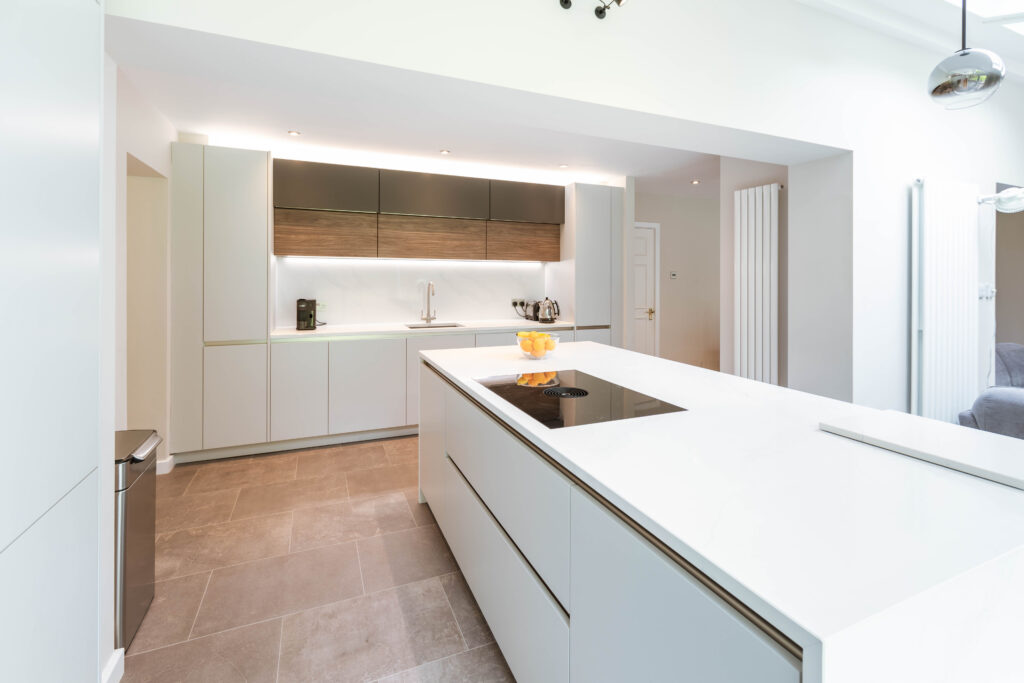
Zone-based planning organises the kitchen into five functional areas, each with its own equipment, storage and clearance requirements. The aim is to separate zones enough to allow parallel activity, while keeping transitions between them short and logical.
Prep zone. The worktop running between the fridge and the sink. This is where ingredients arrive, vegetables are chopped, and food is assembled before it reaches heat. It should sit closest to the main fridge and be well-served by storage for knives, boards and small tools. Schüller’s technical planning guidelines specify a minimum continuous prep run of 900mm in a working kitchen; 1,200mm is meaningfully more useful in a family kitchen where two people prepare food simultaneously.
Cook zone. Centred on the hob and oven or ovens. Heat, splashback, extraction, this zone should be isolated from regular circulation routes. Nothing should pass through it consistently. Adjacent landing space of at least 400mm on both sides of the hob is essential for safe use and comfortable plating.
Clean zone. Sink, dishwasher and waste management. The dishwasher should always be adjacent to the sink, with the bin nearby. This zone is most often disrupted by poor early planning, a dishwasher door that opens into the main walkway, or a bin positioned so it is blocked when the dishwasher is open, are entirely avoidable problems that create daily friction for the entire life of the kitchen.
Store zone. All storage: larder units, tall cabinets, base drawers, wall units. In modern German kitchen design, the move towards full-height storage consolidates this zone into one or two tall unit columns rather than distributing base storage throughout the full room.
Serve zone. The handover point where food leaves the kitchen. In open-plan spaces this is the island or breakfast bar; in enclosed kitchens it is the worktop closest to the dining area. It should be accessible without passing through either the prep or the clean zones during service.
Designing these five zones explicitly, rather than fitting appliances into available wall space, consistently produces layouts that feel more settled and require less effort in daily use. Learn more about our company and how we design, supply and install kitchens tailored to the way you live.
how to test a layout before you commit to anything
Paper-testing a layout before plans are finalised takes less time than most people expect, and it regularly catches problems that scale drawings miss entirely.
Print your floor plan at 1:20 scale on A3 paper. At this scale, 1mm on paper represents 20mm in reality, a standard 600mm base unit becomes a 30mm square. Cut card representations of each appliance and unit group, and lay them on the plan.
Then test the three sequences that recur most frequently in your household:
Arrival sequence: front door → bags down → fridge → kettle or coffee machine. Does this route cross the main cooking run? If it does, it is a reliable source of daily interruption that worsens when the kitchen is actively in use.
Cooking sequence: fridge → prep zone → hob → plating → serve zone. Is the movement broadly linear, or does it double back on itself repeatedly?
Clear-down sequence: dining table → sink → dishwasher → bin → storage. Is the clean zone clear of the cook zone? Does the dishwasher door create a bottleneck when open?
If any of these sequences requires crossing an active zone, or opening a door into someone’s path, that is a layout problem worth resolving at the planning stage, not after the cabinets are on the wall.
The clients who get the most out of their layout are usually the ones who can describe what frustrates them about their current kitchen, not the ones who have collected the most online inspiration. When someone tells me ‘we constantly get in each other’s way when we both cook’, that is incredibly useful design information. It tells me where the prep zone needs to sit, how the island should be oriented, and how wide the main walkway needs to be. No mood board tells you that. My advice for anyone at the start of the process: spend a week paying close attention to where your current kitchen annoys you, not where it looks outdated. The functional improvements will outlast the aesthetic ones by years.
common mistakes to avoid
Designing for the ideal-use scenario rather than the everyday one. A kitchen should function on a Tuesday evening, not only at a dinner party. The everyday sequence: arrival, quick meals, school mornings – is the one that reveals layout problems.
Over-specifying island size relative to room dimensions. A kitchen that can physically fit an island is not always a kitchen where an island improves workflow. Without 1 metre of clear walkway on all sides, the island becomes an obstacle.
Placing the dishwasher away from the sink, or opening it into the main walkway. These problems are invisible on a floor plan but create daily disruption for the entire life of the kitchen.
Treating bin placement as an afterthought. Waste storage needs to sit in the clean zone with full door clearance – a pull-out bin unit next to the sink is the most effective solution, but it needs to be specified early.
Routing the hob into a thoroughfare. Particularly relevant in open-plan extensions where children move regularly between the living and dining spaces; the cook zone should never be on a circulation route.
Leaving the serve zone unplanned. Where food leaves the kitchen affects how everyday meals and entertaining feel. It deserves as much thought as where food is prepared.
frequently asked questions
Should I have an open-plan kitchen?
Open-plan works well for entertainers and families who want to supervise children from the kitchen. It suits households where the kitchen is a social hub. It is less well-suited to homes where cooking smells and noise in the living space are unwelcome, or where one person regularly works from home in an adjacent room. The question is primarily about how your household functions, not about what the space looks like.
How big does a kitchen need to be to work well?
A well-designed single-run galley kitchen at 2.4m × 3.6m can be highly functional. Total floor area matters less than proportions. Kitchens narrower than 2.1m make parallel cooking difficult. More important than size is whether the five zones can be laid out without zones overlapping or circulation routes passing through active cooking areas.
What is the best kitchen layout for a family of four?
A U-shape or L-shape with a peninsula typically suits families well – it provides a long worktop run, separates prep from household circulation, and gives children somewhere to sit without being inside the cooking zone. An island can work well if there is sufficient clearance. Where room dimensions are tighter, a peninsula is usually more practical than an island and is often better value.
Is a kitchen island always a good idea?
Not always. An island needs at least 1 metre of walkway clearance on all sides to function properly. In rooms under approximately 4 metres wide, an island creates a bottleneck rather than additional workspace. A peninsula attached to a run or wall is frequently a better solution in medium-sized rooms – it provides the same preparation surface and seating options with less impact on circulation.
How wide should kitchen walkways be?
A single-cook kitchen can work with 900mm of clearance between facing units or appliances. For two people to pass comfortably, 1,100mm is the practical minimum. In kitchens with an island where two cooks are regularly active at the same time, 1,200mm on each side of the island is a more comfortable and workable target.
Where is the best place to put the bin in a kitchen?
The bin belongs in the clean zone, adjacent to the sink and dishwasher. It needs enough clearance in front for the door to open without blocking the route to either. A pull-out bin inside a base cabinet next to the sink is the most common and effective solution. A freestanding bin placed in a walkway creates consistent low-level friction that compounds over years of daily use.
Wherever you are in your kitchen plans, a short conversation with one of our designers can save weeks of second-guessing. Chat with a designer – no pressure, no sales pitch, just practical guidance grounded in real installation experience.