 0161 962 7261
the kitchen triangle is out, here’s what designers use instead in 2026
Quick answer: The kitchen work triangle was developed in the 1940s for single-cook, closed-plan kitchens with just three fixed appliances. In 2026, open-plan layouts, second sinks, multiple fridges and parallel cooking have made it a poor fit for most homes. Modern kitchen designers use a five-zone model: prep, cook, clean, store and serve – that works across any layout type and accounts for how you actually use the room, not just who stands at the hob.
The work triangle has appeared in almost every consumer guide to kitchen design for the past seventy years. Ask a working kitchen designer whether they still use it, and most will pause. The concept is not wrong, exactly – it just wasn’t designed for kitchens like the ones being built today. Open-plan living, islands, multiple cooks, steam ovens and dedicated coffee stations have changed the problem. This article explains where the triangle falls short and what experienced designers use instead.
why the kitchen triangle made sense and where it breaks down
The work triangle was developed at the University of Illinois in the late 1940s as part of research into kitchen efficiency for small homes. The principle was simple: in a closed-plan kitchen with a hob, a sink and a refrigerator, minimising the walking distance between those three points reduced fatigue. The recommended total perimeter sat between 4m and 7.9m, with no single leg shorter than 1.2m or longer than 2.7m.
For the kitchen it described, this was sound advice. The problem is that the triangle assumes one cook, three appliances and a closed room. In most kitchens being designed today, none of those assumptions hold. A kitchen with a prep sink in the island and a main sink at the perimeter has two sink vertices, not one. An open-plan kitchen where the fridge is accessed from the dining side as well as the cooking side doesn’t behave like a static workflow point. And a kitchen where two people regularly cook at the same time has two sets of circulation patterns, not one, the triangle captures neither of them accurately.
The Kitchen Bathroom Bedroom Specialists Association (KBSA) notes that inadequate circulation planning is among the most common post-install complaints, and much of that traces back to layouts designed around triangle geometry that didn’t reflect how the household actually uses the room. To avoid the most common installation issues before your project begins, read this “What Goes Wrong During a Kitchen Installation, And How To Avoid Expensive Mistakes”.
the five-zone model: what designers actually use
The five-zone model organises a kitchen around activities rather than individual appliances. The zones are: Prep, Cook, Clean, Store and Serve. Each groups together the surfaces, storage and appliances that belong to a single task.
| Zone | What belongs here | Typical minimum run |
|---|---|---|
| Prep | Main worktop, prep sink, knife storage, small-tool drawers | 900–1,200mm |
| Cook | Hob, oven(s), extraction, oils and spices adjacent | 300mm landing each side of hob |
| Clean | Main sink, dishwasher, drying space | 400mm beside sink |
| Store | Fridge, freezer, larder, pantry | Distributed or consolidated run |
| Serve | Plates, glasses, snack storage, proximity to table | Close to dining area |
Unlike the triangle, zones don’t require appliances to be at fixed points relative to each other. They simply require that the surfaces and storage that belong together are grouped together, which scales to any size of kitchen and any number of cooks. To compare the differences between kitchen chains, independent studios and bespoke makers, read this “Kitchen Chain, Independent Or Bespoke Maker, Which Suits Your Home?”.
how the zones work across different layouts
The practical strength of zoning is that it works in every layout type.
Galley kitchen: Zones run along two parallel runs. Typically, prep and clean sit on one side and cook on the other, with serve at the exit point nearest the table. The key is that the cook zone should not be sandwiched between prep and clean on the same run, as this creates a single chokepoint.
L-shaped kitchen: The corner naturally takes the prep zone, with cook on one leg and clean on the other. Corner storage needs to be genuinely usable, a pull-out unit or Le Mans fitting, not a dead deep corner.
U-shaped kitchen: The most zone-friendly layout. Each run carries a zone, with store distributed at the ends. The opening must be at least 1,200mm wide to let two people pass without blocking each other, a detail that Schüller’s also specify as a practical minimum for comfortable kitchen use.
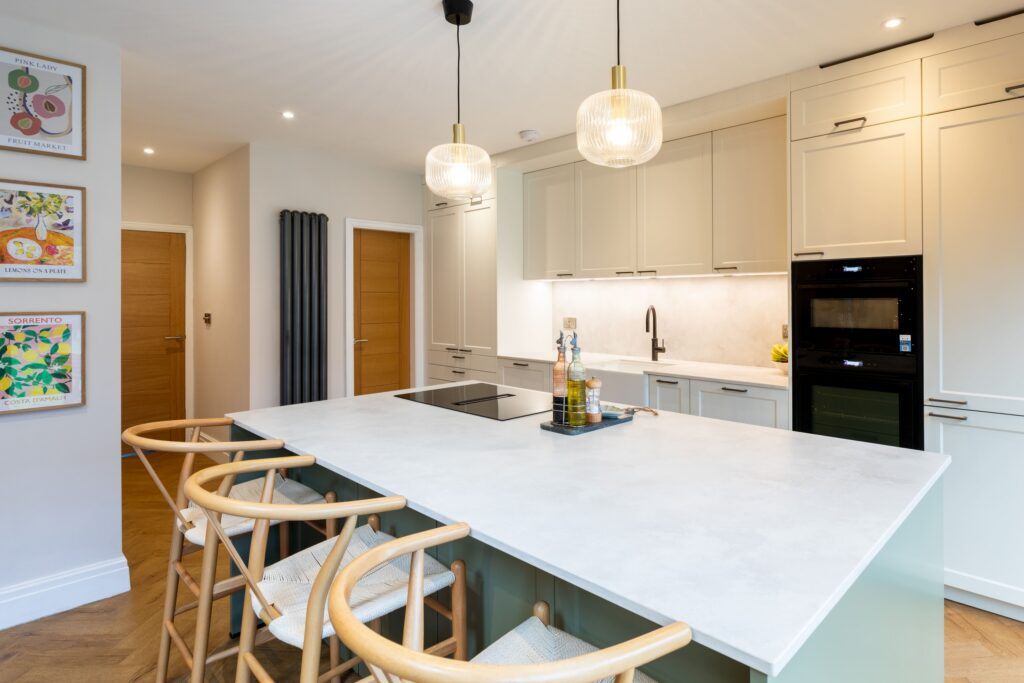
Island kitchen: The island becomes its own zone, most often prep or serve, and sometimes both. Whether the island should carry a hob or a prep sink depends entirely on the household’s priorities.
To compare the differences between kitchen chains, independent studios and bespoke makers, read this “Kitchen Chain, Independent Or Bespoke Maker, Which Suits Your Home?”.
the clearance numbers that actually matter
Rather than optimising triangle perimeters, designers work to practical clearance minimums:
- Walkway between parallel runs: 1,000mm for a single cook; 1,200mm for two
- Landing space beside a hob: 300mm minimum on each side
- Clearance in front of an oven for safe door opening: 900mm
- Standard worktop depth: 600mm; 650–700mm if deeper appliances are specified
- Worktop height: 870–900mm standard, adjustable in a bespoke scheme
These aren’t aspirational targets, they’re the working minimums below which a kitchen becomes genuinely uncomfortable or unsafe to use. They apply regardless of whether the layout is a galley, L, U or island configuration.
“The work triangle comes up in almost every initial client conversation, usually from someone who has done their research, which I always respect. My view is that it gives people a useful vocabulary for thinking about movement, but it can also send them in the wrong direction. I’ve seen clients fixate on triangle geometry in a layout where an island completely changes the circulation, or where there are two people cooking every evening and the triangle only accounts for one of them.
What I find more useful is asking the client to walk me through a typical Sunday morning, who is making coffee, who is unloading the dishwasher, where the children sit, what’s on the hob. That conversation tells you where the zones should go. The triangle rarely does.”
Cassandra Wilkinson-Leonard, Senior Designer, Suga Küchen
common mistakes to avoid
- Designing around triangle geometry in an open-plan space where the layout has two or more of the same appliance type, or where circulation crosses the cooking area from multiple directions.
- Placing prep and clean zones far apart carrying wet ingredients across the room is one of the most common day-to-day frustrations in poorly planned kitchens.
- Treating the serve zone as an afterthought. Where plates, glasses and snacks land at mealtimes matters as much as where food is cooked particularly if children or guests are regularly in the room.
- Over-loading an island with too many functions. An island that carries a hob, a prep sink and seating often serves none of those roles well. Choose a primary zone for the island and design the rest of the kitchen accordingly.
- Ignoring the non-cook traffic. A good layout accounts for everyone who moves through the kitchen, not only whoever is at the hob.
frequently asked questions
Is the kitchen triangle wrong?
Not wrong, exactly, it was a valid principle for the kitchens it was designed for. In a simple, closed-plan, single-cook kitchen with three appliances, the triangle still provides a reasonable guide. The problem is that most modern kitchens don’t fit that description. Open-plan layouts, islands, additional appliances and multiple cooks all undermine its core assumptions.
What replaced the kitchen triangle?
The five-zone model: prep, cook, clean, store and serve – is now the working framework most experienced designers use. Rather than optimising appliance-to-appliance distances, it organises the kitchen around tasks and the people performing them. It works at any scale and in any layout type, which the triangle does not.
How big should each zone be?
Zones are sized to reflect how you use the kitchen, not to a fixed rule. A household that cooks from scratch most evenings needs a generous prep zone – at least 900–1,200mm of uninterrupted worktop. A household that entertains regularly will want a serve zone accessible without crossing cooking traffic. The right size for each zone comes from a detailed lifestyle brief, not a formula.
Can I have two cook zones in one kitchen?
Yes, and it’s increasingly common in larger kitchens – a main hob on the perimeter plus a secondary induction zone in an island, for example. When there are two cook nodes, zoning still applies: each needs its own landing space and proximity to a prep surface. The circulation pattern becomes more complex, which is where a designer adds real value.
What zone should a kitchen island be?
It depends on the household. An island is most often a prep extension (prep sink, drawer storage, worktop run) or a serve zone (stools, accessible storage, proximity to the table). A hob island is a cook zone – but it demands careful extraction planning and clear 1,000–1,200mm clearance on all sides. The decision should be made before the island is designed, not after.
What zone should a kitchen island be?
The zone model is a planning framework, not a regulation. The non-negotiable elements are the safety clearances – landing space beside the hob, oven-door clearance, walkway widths. Beyond those, the goal is a layout that works for the specific way your household uses the kitchen, and zoning is simply the clearest way to work that through before anything is ordered.