 0161 962 7261
what kitchen lead times actually look like in 2026 (and why german brands are worth the wait)
Quick answer: In 2026, kitchen lead times run from 4–8 weeks for chain retailers, 8–14 weeks for German factory-made kitchens such as Schüller and next125, and 16–24 weeks for bespoke handmade makers. German kitchens take longer because every cabinet is manufactured to your exact specification after you place the order, there is no pre-built stock. Planning your project with this window built in from the start prevents costly delays on site.
One of the most common surprises in a kitchen project isn’t the price, it’s the wait. Homeowners who assume they can order a kitchen in June and be cooking in it by August are often disappointed, particularly if they have chosen a German brand. This article sets out what lead times realistically look like in 2026 across the three main routes, chains, German factory kitchens, and bespoke handmade, explains precisely why German kitchens take longer to arrive, and gives you a practical framework for planning your project around the manufacturing window rather than being caught off-guard by it.
how long do different kitchen types take in 2026?
Lead times vary significantly depending on how and where your kitchen is made. The table below reflects current 2026 conditions, these are from order confirmation to delivery on site, and do not include the design and planning phase beforehand, which typically adds a further 4–10 weeks.
| Kitchen type | Typical 2026 lead time | What drives it |
|---|---|---|
| Chain retailers (Wren, Magnet, Wickes) | 4–8 weeks | Stocked in UK warehouses, semi-standardised sizing |
| German factory kitchens (Schüller, next125, Keller) | 8–14 weeks | Made to order in Germany, no pre-built warehouse stock |
| Bespoke handmade (Tom Howley, Plain English etc.) | 16–24 weeks | Hand-crafted, queue-based production |
why german kitchens take 8–14 weeks (and why that is a feature, not a problem)
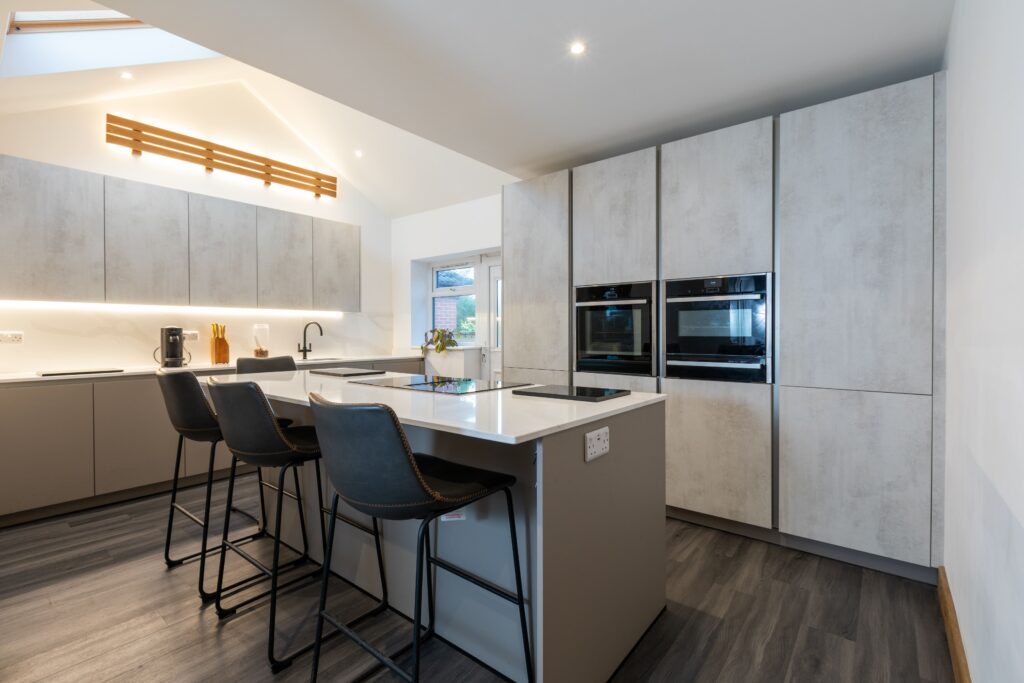
The longer lead time for German kitchens is a direct consequence of how they are built. Every Schüller kitchen is manufactured to your specific dimensions, finishes, and configuration after your order is placed. There is no distribution depot in the UK holding pre-built carcasses waiting to be dispatched. The factory in Bavaria begins your kitchen from scratch once the order is technically confirmed and your cutting list is locked.
This matters in practice because it means every cabinet is built to the tolerances your design demands. Schüller manufactures to ±0.5mm precision, achievable only in a purpose-built, order-led production run, not from warehouse stock that might be cut down or padded out to fit a non-standard space. The cabinet built for a 2,340mm high alcove in your particular kitchen is not the same cabinet used in the house down the road.
The 8–14 week range reflects variation in finish complexity. Standard lacquered and foil-wrapped doors sit towards the lower end. Certain glass fronts, high-gloss lacquers with extended cure times, or rare colour specifications can push a delivery towards 14 weeks or slightly beyond. At point of order, your designer will confirm the specific lead time for your configuration.
chain kitchens arrive faster, but there is a trade-off
The 4–8 week lead time from a chain retailer reflects a different production model: cabinets are manufactured in standardised dimensions, held in regional warehouses, and picked and delivered to order. The speed is genuine. The constraint is flexibility.
Standard carcass sizing means the design adapts around the product’s fixed dimensions, rather than the product being built around your space. In rooms with non-standard ceiling heights, tight chimney-breast alcoves, or awkward corner runs, all common in period properties across Altrincham, Hale, Wilmslow, and the wider Cheshire area, this frequently results in filler panels, dropped unit heights, or lost corner storage that a made-to-order kitchen would have resolved cleanly in the factory.
how to plan your project around the manufacturing window
The biggest single source of kitchen project delays is not the manufacturer, it is homeowners who do not build the lead time into their overall project schedule from the outset. A practical framework:
- Agree the full technical design before placing the order. Any significant change after order sign-off can reset the manufacturing clock. Finalise appliance specifications, door colours, and worktop material before you confirm.
- Place your kitchen order before your builder starts. For a German kitchen, 8–14 weeks from order to delivery means placing the order before groundworks begin on an extension, not after the walls go up and the plasterer moves out.
- Treat the delivery date as a fixed point and work backwards. If you want the kitchen installed in November, you should be signing off the technical design by August at the latest.
- Confirm appliance lead times separately. Appliances carry their own lead times, certain built-in ovens or refrigeration units can take 6–10 weeks from order. If a dishwasher or fridge arrives a fortnight after the kitchen, your fitter may need a return visit, which extends the overall programme.
- Build a two-week float before your install start date. Preceding trades, floor screeds, plastering, ceiling works, are the most common cause of a shifted kitchen install start. A small buffer absorbs these without derailing the programme.
For a detailed view of the full kitchen project timeline from discovery through to sign-off, see our guide: How Long Does a New Kitchen Actually Take? A Realistic Timeline From Design to Sign-Off.
are german lead times in 2026 longer than in previous years?
Post-pandemic supply chain disruption pushed some German manufacturers beyond 20 weeks in 2022 and early 2023. By mid-2025, production had largely normalised. Schüller’s current lead times are back within the historical 8–14 week band. next125, Schüller’s premium architectural sister brand, tends to sit at the 12–14 week end of that range, reflecting additional finish complexity in its production process.
Seasonal demand does affect factory loading. Orders placed in January and September, when new builds and post-summer renovation projects converge, occasionally push lead times towards the upper end of the range. If you have a fixed completion date, it is worth confirming current factory capacity at the point of order rather than assuming the standard window.
“The projects that run most smoothly are the ones where the client understood the manufacturing window before they committed to a builder start date. When someone comes to us saying the builder has finished and they want the kitchen in four weeks, the options become very limited very quickly. German kitchens aren’t slower, they’re made for you, to the millimetre. That means the clock starts when your technical design is locked, not when you first walk through the showroom door. Build the wait into your plan from day one and it becomes a complete non-issue.” Danil Sugakov, Director, Suga Küchen
common mistakes to avoid
Assuming a shorter chain-retailer lead time means faster overall installation. Delays on the build side: plastering, screeds, electrics – apply regardless of who makes your kitchen.
Placing the kitchen order before the technical design is fully agreed. Changes after the cutting list is submitted to the factory can reset the lead time and, in some cases, incur amendment costs.
Treating appliance lead times as an afterthought. Built-in appliances carry independent lead times that need to be tracked alongside the cabinetry order.
Fixing a build completion date and then ordering the kitchen. The correct sequence is to fix the order date and work backwards to your build programme, not the other way around.
Not re-confirming current factory lead times at the point of order. Factory loading fluctuates with seasonal demand; the figure in a brochure may not reflect the week you are ordering.
Underestimating design phase time. The 8–14 week manufacturing window begins after design sign-off, not after your first showroom visit. Allow 4–10 weeks of design work before the clock starts.
frequently asked questions
Can a German kitchen come faster than 8 weeks?
In most cases, no. The 8-week lower end of the range reflects the minimum time required for factory production, quality control, and logistics from Germany to the UK. Some manufacturers offer a limited range of standard configurations at shorter lead times, but these sacrifice the made-to-order precision that characterises German kitchen manufacturing. If speed is critical, it is worth discussing your timeline with a designer before committing to a specific brand or specification.
What if I urgently need a kitchen installed?
If you are in a genuinely urgent situation, a new build handover, a rental property, or an emergency replacement, a chain retailer or in-stock British manufacturer is the realistic route. For a premium kitchen with limited flexibility on timing, the most practical advice is to order as early as possible and to be clear with your designer about the hard deadline. Some schedule flexibility can sometimes be arranged, but it is not standard and should not be assumed.
Are German kitchen lead times in 2026 worse than they were in 2024?
No, the situation has improved considerably. The 20+ week delays that affected some German manufacturers in 2022–2023 have resolved. Current 2026 lead times for Schüller and next125 are back within the pre-pandemic 8–14 week range. That said, factory loading can vary month to month, particularly during peak ordering seasons in January and September, so it is always worth confirming the current position at point of order.
Are appliances on the same lead time as the kitchen?
No. Appliances are ordered separately, typically from the appliance manufacturer or distributor, and carry their own lead times. For standard models from major brands, 2–4 weeks is typical. Specialist appliances, certain integrated refrigeration columns, steam ovens, or less common finishes, can take 6–10 weeks. Your designer should flag this at the point of order and ensure appliance delivery is scheduled to align with the kitchen install, not arrive before or significantly after it.
Can I order the kitchen in stages to manage cash flow or the build programme?
In most cases, a German kitchen is ordered as a single consignment. Splitting an order across multiple manufacturing runs is generally not practical, it introduces the risk of batch variation in finishes and complicates installation sequencing. If phasing is important to your project, discuss this with your designer at the outset. Some flexibility is possible in the installation sequence (for example, fitting base units before wall units), but the manufacturing and delivery tends to be a single event.
Does the design phase count toward the lead time?
The manufacturing lead time, 8–14 weeks, begins after the technical design is signed off and the order is placed. The design phase itself runs before this and typically takes 4–10 weeks depending on the project’s complexity, how quickly decisions are made, and how many design iterations are needed. From first showroom visit to kitchen delivery, most projects run 16–24 weeks in total, which is why starting the conversation earlier than feels necessary is almost always the right call.
Wherever you are in your kitchen plans, a short conversation with one of our designers can save weeks of second-guessing. Chat with a designer no pressure, no sales pitch, just practical guidance grounded in real installation experience.
Written by Danil Sugakov, Director, Suga Küchen. Last updated 13 May 2026.