 0161 962 7261
what makes next125 different from other german kitchens?
Quick answer: next125 is Schüller’s dedicated design label: it uses the same German factory and engineering standards but focuses exclusively on architectural minimalism, with tighter proportions, recessed handle systems and a reduced palette designed for homeowners who want precision design rather than a broad catalogue. It sits above Schüller on price and suits contemporary or open-plan homes where the kitchen is the visual centrepiece.
If you’ve been researching German kitchens for a while, you’ve probably come across next125 mentioned alongside Schüller, sometimes in the same sentence, as though they’re interchangeable. They’re not. While both come from the same manufacturer and share the same underlying construction standards, they are aimed at distinctly different design intentions and different homeowners.
This article explains what next125 actually is, what distinguishes it from Schüller in practical and visual terms, who it genuinely suits, and what a few things owners wish they’d considered before committing. If you’re weighing next125 against other premium German options, our guide to all three German brands we stock gives a broader comparison to sit alongside this one.

what next125 actually is
Next125 is Schüller’s dedicated design programme, not a sub-brand in a diluted sense, but a deliberately separate identity with its own design team, its own catalogue, and its own visual language. It was developed to sit above Schüller’s main range and address a specific type of project: one where the kitchen is expected to read as architecture, not just as furniture.
The engineering foundations are identical to Schüller: 19mm carcasses, Blum or Hettich hardware, made-to-order at the Schüller factory in Herrieden, Bavaria. What changes is everything visible — the door proportions, handle integration, colour and material palette, and the overall system logic. next125 works within a tighter, more considered set of options. It doesn’t offer the same breadth as Schüller’s main range, and that’s a deliberate design decision rather than a limitation.
the handle systems: where next125 really differs
The most immediately visible distinction is how next125 handles handleless design. Most handleless kitchens use a J-pull profile cut into the door, a routed recess at the top or bottom edge that works fine but is essentially a standard detail. next125’s signature is the recessed rail handle (the NX 902 being the most recognised), an integrated aluminium channel that runs across the full door width and sits flush with the surface plane.
The effect is visually quieter: no shadow gap, no visible cutaway, just a precisely engineered line. It also has practical consequences, the rail is wide enough to grip properly, which matters for households where multiple people are opening drawers and doors throughout the day. In a kitchen with ten or twelve drawers, the handle system is something you interact with dozens of times a day, and the feel of the NX 902 is noticeably more considered than a standard J-pull.
Next125 does offer conventional handle options for homeowners who prefer them, but the majority of clients who choose next125 do so specifically for the recessed rail systems.

design language: architectural minimalism
Next125 doors are produced in a deliberately refined palette: matt lacquers, real wood veneers and glass finishes are available, but they’re curated rather than comprehensive. Where Schüller’s main catalogue offers hundreds of colour and finish combinations, next125 concentrates on a smaller range that’s been selected for how surfaces behave in different light conditions and alongside contemporary materials like concrete, stone and large-format tile.
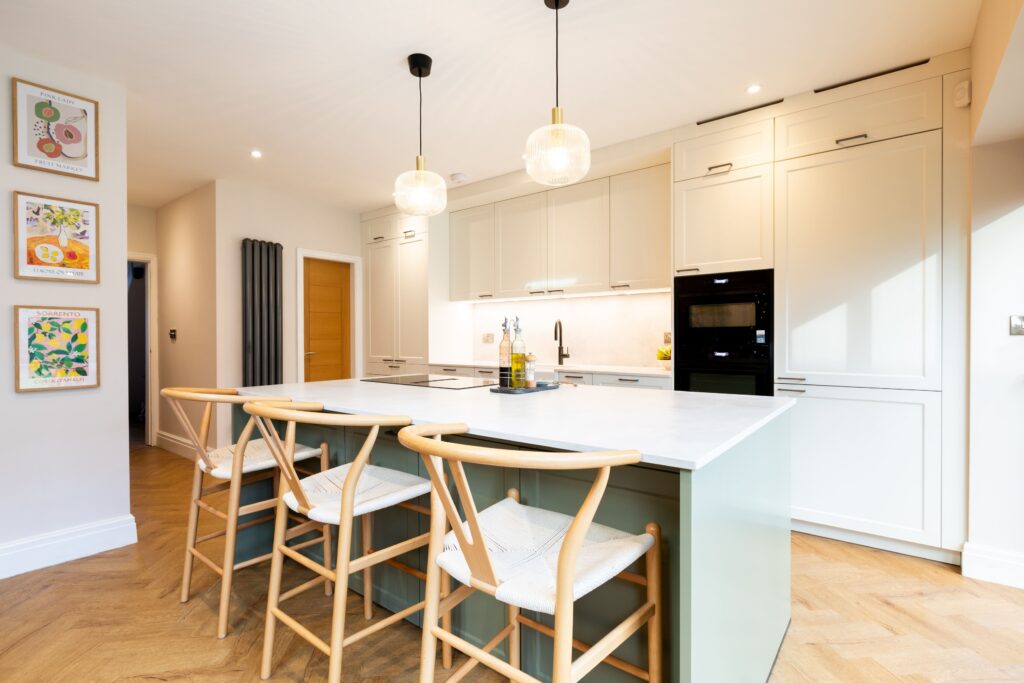
The proportion of the door profiles is slightly different too: thinner reveals, flatter faces, less tolerance for ornament. It’s a system designed to recede from attention as well as command it: in an open-plan kitchen, next125 tends to read as a coherent architectural surface rather than a collection of individual units.
This matters most in extension projects, knockthroughs, and new builds where the kitchen sits in a large, visible space with architectural glazing. In a small galley kitchen or a room with a lot of existing character, next125’s visual restraint can sometimes work against it.
how next125 compares to schüller on price and customisation
| Factor | Schüller | next125 |
|---|---|---|
| Factory & engineering | Herrieden, Bavaria | Same factory, same construction |
| Price tier | Mid to upper-premium | Upper-premium |
| Colour & finish range | Very broad | Curated, narrower |
| Handle systems | Wide range including conventional | Recessed rails signature; conventional available |
| Design language | Modern to transitional | Architectural minimalism |
| Best suited to | Broad range of homes and briefs | Contemporary, open-plan, statement spaces |
| Lead time | 8–14 weeks | 8–14 weeks |
Pricing varies by specification: door choice, worktop, appliances and size all move the figure, but as a general guide, a comparable kitchen in next125 typically runs 15–25% higher than the equivalent Schüller specification. That premium reflects the design programme and the curated material selection, not a difference in core construction.

who next125 actually suits
Next125 tends to work best for homeowners who are building or extending rather than replacing like-for-like, because the design language is calibrated to contemporary architectural spaces. It suits people who’ve spent time thinking about how they want the kitchen to sit within the room, rather than those choosing a style from a catalogue and fitting it around existing constraints.
It also suits homeowners who won’t be fighting the palette. Because next125’s strength is restraint, it reads best when the surrounding materials: flooring, worktops, wall colours – are similarly considered. In a period property with ornate plasterwork and traditional tiles, the precision minimalism of next125 can feel at odds with its surroundings rather than complementary to them.
Practically: if your brief is “I want it to look like a kitchen”, next125 might be more than you need. If your brief is “I want the kitchen to look like part of the architecture”, it’s worth a closer look.
what next125 owners commonly wish they’d known
Conversations with clients who’ve lived with next125 for a year or more surface a few consistent reflections. The most common: the NX 902 rail handle shows fingerprints more readily than a conventional handle on a lacquer surface, particularly in kitchens with a lot of natural light. It’s a minor thing and easy to maintain, but worth knowing before you specify a pale matt finish in a south-facing room.
The second: because the palette is curated, changing your mind on a colour mid-project has fewer easy alternatives within the range. With Schüller’s broader catalogue, a late colour switch is usually resolvable. With next125, the options are more defined, so it rewards committing to the design brief early.
Neither point is a reason not to choose next125, most owners who raise them still say they wouldn’t change the choice. They’re worth knowing so the planning process accounts for them.
“The question I ask clients who are drawn to next125 is: are you designing the kitchen, or are you designing the room? For most Schüller projects, the kitchen is the focus, we’re making it look as good as it can within the space. For next125 projects, the kitchen is usually one element of a larger spatial intention, and the brief typically starts with the architecture rather than the units. Those are very different conversations, and they produce very different results. next125 doesn’t suit every home, but in the right space, an open-plan extension, a new build with large glazing, a contemporary interior with restrained material choices, it’s one of the most considered kitchen systems I’ve worked with.” – Cassandra Wilkinson-Leonard, Senior Designer, Suga Küchen
common mistakes to avoid
- Choosing next125 for the handles alone. The NX 902 is striking, but it’s a system built for a particular design language. If the rest of the kitchen specification isn’t aligned, the handle looks out of place rather than intentional.
- Assuming a broader palette is available. next125’s curated range is a strength in a coherent brief, but homeowners used to Schüller’s main catalogue sometimes expect the same breadth. Check the current collection before you fall in love with a colour that isn’t available in this programme.
- Installing it in a room with too many competing styles. next125’s minimalism requires some visual breathing room. In a kitchen surrounded by heavy architectural detail, it can read as austere rather than elegant.
- Underestimating the specification commitment. The narrower palette means late-stage changes are less easily absorbed. Lock in the brief before ordering.
- Treating it as “Schüller, but better”. It’s a different design programme, not an upgrade. Schüller’s main range is the better choice for many briefs. next125 is specifically right for certain types of project, not universally superior.
frequently asked questions
Is next125 worth it over Schüller?
It depends entirely on the project. Both use the same factory and the same engineering. next125 is worth the premium if your brief is architecturally focused, your space is contemporary, and you want a curated, minimal design language. If you want a broader range of styles and more flexibility mid-project, Schüller’s main range is likely the better fit. The decision should be driven by the design brief, not by the price differential alone.
Is next125 only for modern homes?
Not strictly, but it performs best in contemporary spaces. The architectural minimalism and tight proportions are designed for rooms where clean lines and restrained materials are already part of the interior. In a characterful period property with traditional features, the contrast can be difficult to resolve well. A designer can advise whether the specific space would suit it.
What’s the most popular next125 handle model?
The NX 902 recessed rail handle is the most recognised, it’s the signature detail of the range and appears in most next125 showroom displays. The NX 500 and NX 901 are also popular. The “right” handle depends on the door finish and the visual weight you want in the space. A designer will usually sample several options before specifying.
Does next125 do conventional handles?
Yes. While the recessed rail systems are what next125 is known for, the range does include conventional bar handles and knob options. These tend to be chosen less often, partly because the integrated rail is what draws most clients to next125 in the first place, but they’re available for projects where a conventional handle suits the design better.
What appliances work best with next125?
Next125 works well alongside fully integrated appliances from Siemens, Gaggenau, Miele or Bosch, particularly where appliance fronts are fitted to match the door finish for a flush, unified look. Freestanding or semi-integrated appliances can work, but the design logic of next125 tends to favour integration. Appliance doors and panel specifications should be confirmed before the kitchen is ordered.
How long does next125 take to arrive?
The same as Schüller: 8–14 weeks from order to delivery, because both are made to order in the same German factory. Lead times in 2026 are broadly stable compared with 2024. Appliances may be on a different lead time depending on the manufacturer and model – worth confirming early so nothing holds up the install programme.
Where can I see next125 kitchens near me?
Suga Küchen’s showroom at 338 Manchester Road, Timperley, Altrincham has next125 displays you can see, touch and open. Appointments are available for anyone who wants to spend time with a designer looking at the range in detail. Visit our next125 page or call 0161 962 7261 to arrange a time.
Wherever you are in your kitchen plans, a short conversation with one of our designers can save weeks of second-guessing. Chat with a designer – no pressure, no sales pitch, just practical guidance grounded in real installation experience.
Written by Cassandra Wilkinson-Leonard, Senior Designer, Suga Küchen. Last updated 1 June 2026.