 0161 962 7261
how much does a german kitchen cost in 2026? a real breakdown for uk homeowners
Quick answer: A complete German kitchen in the UK in 2026 typically costs between £20,000 and £80,000 or more, once cabinetry, worktops, appliances and installation are included.
Entry-level Schüller and Keller projects usually start at £20,000–£25,000, mid-range family kitchens tend to fall between £30,000–£45,000, and premium next125 or fully customised specifications typically sit in the £50,000 to £80,000-plus range.
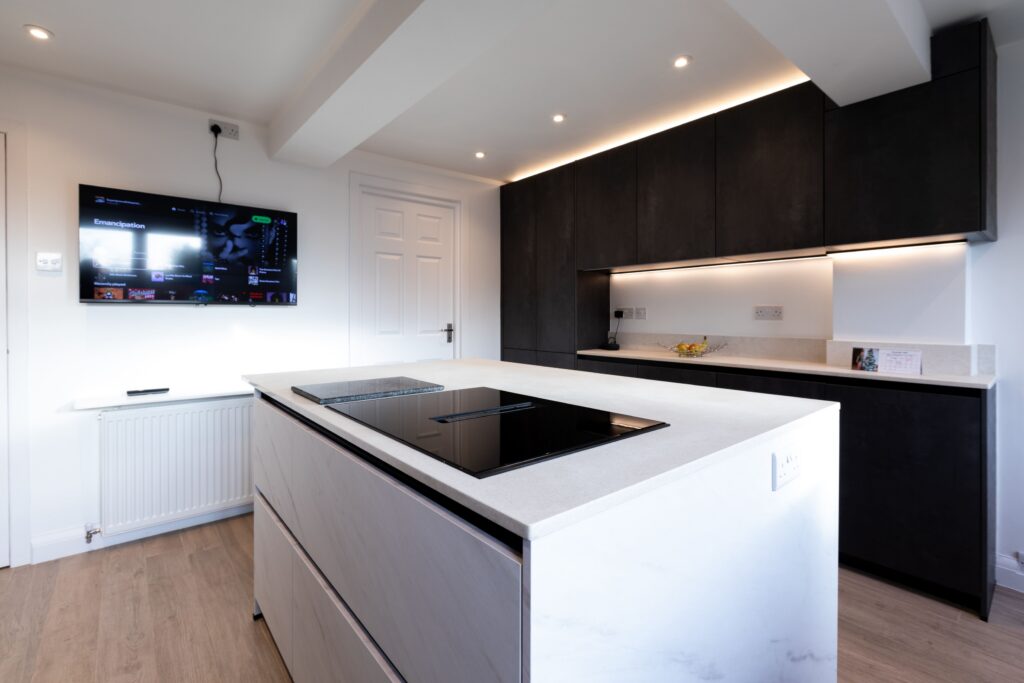
If you’ve started researching German kitchens, you’ve likely already realised that pricing can vary far more than brochures suggest. A Schüller kitchen advertised “from £15,000” can easily become £40,000 once appliances, worktops and installation are factored in.
That isn’t misleading, kitchens are inherently modular, but it does make budgeting more difficult without a clear breakdown of the components. This guide is designed to give UK homeowners a straightforward view of what a German kitchen really costs in 2026, what each price bracket delivers, and where your budget is actually being allocated. It reflects the same conversations we regularly have with families and downsizers in our showroom.
what actually makes up the cost of a german kitchen in 2026
The overall cost of a German kitchen is built from four primary elements: cabinetry, worktops, appliances and installation. Beyond this, there is a secondary layer of costs, including tiling, flooring, lighting, electrics, plumbing, plastering, waste removal and contingency, which together form the true project total.
Cabinetry is typically the largest cost. This includes carcasses, doors, drawers, hinges, runners, internal storage, and any tall units, larders or islands. With brands such as Schüller, Keller and next125, you’re paying for high-spec engineering: 19mm carcasses, dowel construction, Blum or Hettich hardware, and precision tolerances of around half a millimetre, standards that are still uncommon on the UK high street.
Worktops are usually the second most variable element. Laminate sits at the more affordable end, quartz and compact stone occupy the middle, while porcelain and natural stone sit at the premium end. Appliances can significantly influence the total cost, with potential variation of £8,000 or more depending on whether you choose brands such as Neff, Bosch, Siemens, Miele or Gaggenau.
Installation is often underestimated. A professional two- to three-week installation, including templating, appliance commissioning and final snagging, represents a substantial part of the budget and is not an area where cutting costs is advisable.
typical price brackets, what £20k, £35k and £60k+buys you
The clearest way to understand German kitchen pricing in 2026 is to view it in three brackets. Each reflects a realistic total, including cabinetry, worktops, appliances and installation, with VAT.
| Tier | Price range (2026) | Cabinetry | Worktops | Appliances | Best for |
|---|---|---|---|---|---|
| Entry-level German | £20,000 – £25,000 | Schüller C-range or core Keller, matt lacquer fronts | Laminate or compact (e.g. 12mm Dekton-style) | Bosch / Neff core line | Smaller terraces, flats, semis under 12 m² |
| Mid-range family | £30,000 – £45,000 | Schüller next or upper Keller, handleless, integrated lighting | Quartz or 20mm compact stone | Siemens iQ500/iQ700, Bosch Series 8, mid Miele | Family kitchens 14–22 m², open-plan extensions |
| High-end / architectural | £50,000 – £80,000+ | next125 NX recessed-handle, premium Schüller veneers, full customisation | Porcelain, natural stone, statement quartz | Miele, Gaggenau, Wolf, full integration | Larger renovations, knock-throughs, statement homes |
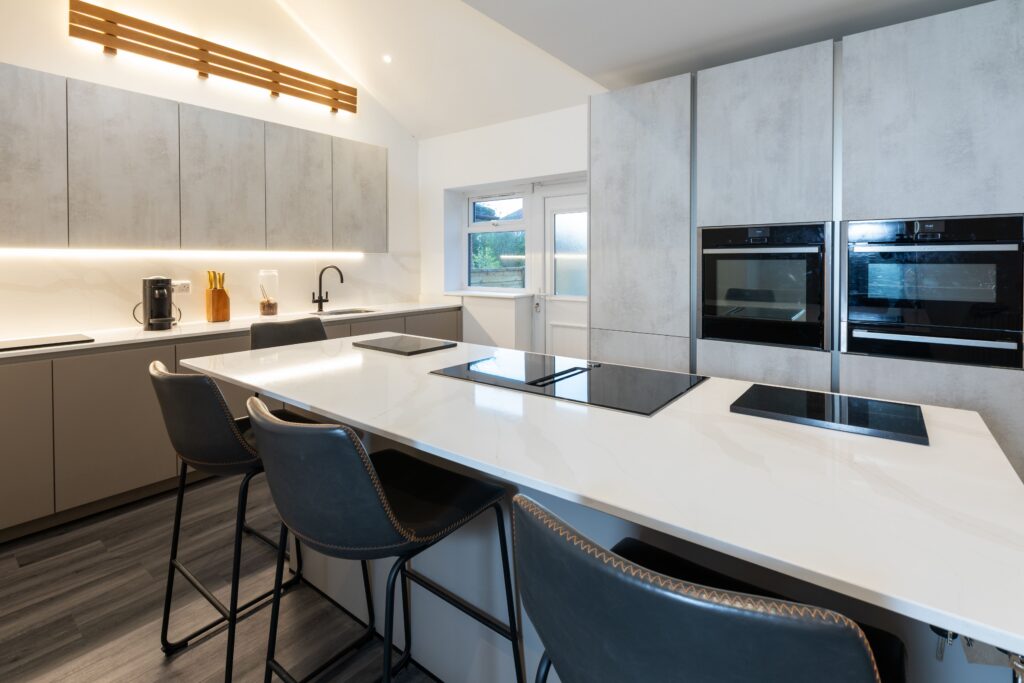
where the money actually goes, a percentage breakdown
The brackets overlap at the edges. A small but very specified entry-level kitchen can easily cross into mid-range; a larger but plainly specified mid-range can come in below £30,000. The bracket is set by the specification, not the room size.
If you take a typical mid-range German kitchen at £35,000, the spend distributes roughly as follows. The percentages shift slightly at the extremes, appliances take a bigger share at the high end, cabinetry takes a bigger share at the entry level, but this is a useful working model.
Cabinetry – ~35%: roughly £12,250 of a £35,000 kitchen. Doors, carcasses, hinges, drawers and internal fittings.
Appliances – ~25%: roughly £8,750. Hob, oven, dishwasher, fridge-freezer, hood and (often) a combination microwave or coffee machine.
Installation – ~15%: roughly £5,250. Two to three weeks of fitter time plus worktop templating and fitting.
Worktops – ~12%: roughly £4,200. Material, edge profile, splashbacks and upstands.
Lighting and electrics – ~5%: ~£1,750. Plinth lighting, under-cabinet LED, additional sockets.
Tiling and flooring – ~5%: ~£1,750 if not part of the wider build.
VAT and contingency buffer – ~3%: ~£1,050 retained for surprises.
The point of the breakdown is not to hold you to it line by line. It is to show that a “kitchen budget” is really seven budgets stacked on top of each other, and that if you have only thought about cabinetry and appliances, you are looking at roughly 60% of the project.
uk-specific cost considerations. vat, install, the old kitchen
German kitchens are designed and built to European standards, but installed in British houses. That gap creates costs that don’t show up on the price list.
VAT at 20% is included in nearly every price you will be quoted by a UK retailer, but it is worth checking. Removal of the old kitchen, including the worktop, appliances and waste, typically adds £400–£1,200 depending on access and skip hire. Plastering after removal is the line that most homeowners forget: even a tidy strip-out usually leaves walls that need patching before tiles or paint can go on, which is another £400–£900.
Gas and electrical compliance is non-negotiable and should be priced in: a Gas Safe sign-off and a Part P electrical certificate are part of the project, not an afterthought. Building Control may also be involved if you are altering load-bearing structures or extending; Local Authority Building Control publishes guidance on what’s notifiable.
For homeowners moving into a new build, costs sit lower because the shell is square, services are placed sensibly and there is no strip-out. For Victorian or Edwardian properties in Altrincham, Hale and Knutsford, where we do most of our work, expect 5–10% more in the secondary layer because walls, floors and ceilings rarely line up.
where you can flex your budget without losing quality
Once you understand the breakdown, the question becomes: where can you save without making the kitchen feel cheap in five years?
Worktops are the most flexible. A laminate worktop at around £200 per linear metre can look excellent in matt finishes; a 20mm quartz at £400–£500 per linear metre is the most popular mid-range choice; porcelain at £600–£800 per linear metre is the upper end. Stepping down one tier on worktops alone can free up £1,500–£3,000.
Appliances are the second most flexible. Bosch Series 6 and Neff N50 deliver 90% of the day-to-day experience of a Miele line for around 60% of the spend. The exception is the dishwasher, where Miele’s longevity often justifies the difference. Doors and finishes also flex: a matt lacquer or laminate front in a high-quality colour gives a near-identical visual outcome to a real veneer at a much lower cost.
The areas we suggest people don’t flex are the carcass spec, the internal organisation (Blum drawer systems, lift-up corner units), and the installation, these are the things that decide how the kitchen feels in year ten. Independent durability research from organisations such as the Furniture Industry Research Association consistently puts hinge, runner and carcass quality ahead of door finish in long-term performance.
what our designers would say
“The single most useful thing a homeowner can do early on is stop thinking of their kitchen as one number and start thinking of it as four. Cabinetry and worktops are where you protect the long-term feel of the kitchen. Appliances and installation are where you make sensible trade-offs based on how you actually cook.
Most overspends I see come from the opposite pattern, saving on the carcass and overspending on a hob nobody uses on full power. We would rather sell a £28,000 kitchen with the right bones than a £40,000 kitchen with the wrong ones.” – Danil Sugakov, Director, Suga Küchen German Kitchens Altrincham.
common mistakes to avoid
Treating the headline price as the project price. A “from £18,000” kitchen rarely lands at £18,000 once worktops, appliances and install are added.
Forgetting the secondary layer. Plastering, electrics, gas, flooring and waste removal commonly add 8–12% to the total, budget for it from day one.
Setting the contingency at 5%. Older properties almost always need 15–20% to absorb out-of-square walls, hidden services and replastering.
Optimising for door finish instead of internal spec. A flashy door on a thin carcass with generic hinges is the configuration that ages the worst.
Ordering before the build is detailed. Manufacture is 8–14 weeks; if the build slips, the kitchen sits in storage. Order timing should be designed, not assumed.
Comparing chain quotes to independent quotes line for line. The two models are priced differently, fitter quality, project management and aftercare are not visible on the order summary.
Need more details? We’re here to help, get in touch.
frequently asked questions
Why are German kitchens more expensive than British ones?
You are paying for tighter manufacturing tolerances, 19mm carcasses (rather than 16mm), better hinges and runners, and a longer-lasting build. Schüller and similar brands operate to roughly half-millimetre tolerances, which is why doors line up after years of use. The premium is largely in engineering, not branding.
Does the price include installation?
Reputable independent showrooms quote installation as a separate, transparent line within the same total. Some chains roll it in; some price it on top after the order. Always ask for installation to be itemised so you can compare like with like.
How much should I budget for appliances separately?
Plan for roughly 25% of the kitchen total. On a £35,000 kitchen that is around £8,500–£9,000, which buys a complete Siemens iQ500 or Bosch Series 8 line-up with room for a Miele dishwasher. Premium Miele or Gaggenau packages run from £12,000 upward.
What is the cheapest German kitchen I can buy?
Realistic entry-level Schüller or Keller kitchens, fully installed with mid-range appliances, start around £20,000 in 2026. Anything below that is usually either a smaller room, a partial kitchen (cabinets only, no install) or a non-German “German-style” alternative.
Are German kitchens cheaper if you go direct to Germany?
Almost never, once you account for shipping, customs, install and warranty. UK independents buy at trade rates and absorb the logistics; you will rarely save money sourcing direct, and you forfeit the local aftercare that makes the warranty workable.
Do German kitchens hold their value at resale?
Estate agents in Cheshire and South Manchester routinely note a quality German kitchen as a positive on listings, and Which? consumer research consistently links well-specified kitchens to faster sales. They don’t add their full cost back to the asking price, but they do shorten time on market and help condition appraisals.
chat with a designer. no pressure, no sales pitch
Wherever you are in your kitchen plans, a short conversation with one of our designers can save weeks of second-guessing. Chat with a designer, no pressure, no sales pitch, just practical guidance grounded in real installation experience.
Written by Danil Sugakov, Director, Suga Küchen. Last updated 28 April 2026.