 0161 962 7261
how long does a new kitchen actually take? a realistic timeline
Quick answer: A new kitchen typically takes 4 to 6 months from first design meeting to final sign-off. The longest single stage is manufacture – 8 to 14 weeks for German-made cabinets, which are built to order rather than pulled from warehouse stock. Installation itself runs 2 to 3 weeks for most projects. Rushing any stage tends to create problems that cost considerably more to fix than the time saved.
For more information about our approach, craftsmanship and kitchen ranges, visit the Suga Küchen main page and explore what sets our projects apart.
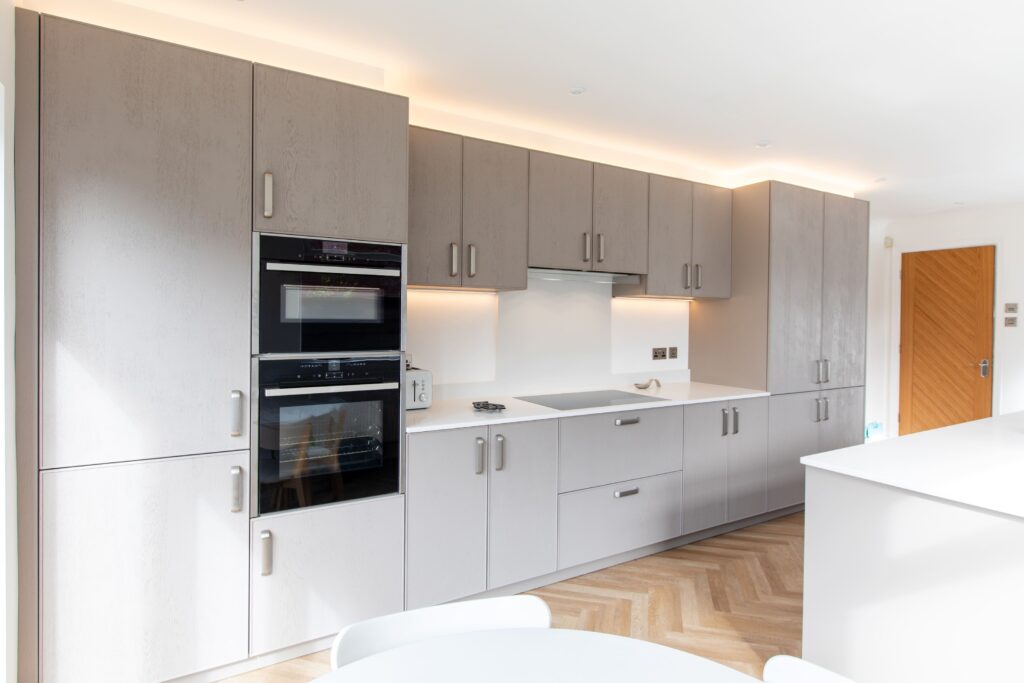
Most homeowners ask this question after they’ve already started, usually after seeing a kitchen they love in a showroom and wondering when they can realistically have it. The answer is longer than most people expect, but there are clear reasons for every week involved. This guide walks through the seven stages of a new kitchen project, from the first conversation with a designer to the final sign-off after installation. It’s written for homeowners in Altrincham, Cheshire and South Manchester who want an honest picture before they commit, not an optimistic headline figure, and not a scare story designed to make the process sound more complicated than it is.
If you’d like to discuss your plans in more detail, book a quote with one of our designers for practical, no-pressure guidance tailored to your space.
the seven stages, and roughly how long each takes
A German kitchen project moves through seven distinct stages. Each has a realistic duration, and understanding where the weeks go makes the overall timeline considerably less surprising.
| Stage | Description | Typical Duration |
|---|---|---|
| 1. Discovery | First consultation, lifestyle audit, brief-building | 1–2 weeks |
| 2. Concept design | Initial layouts, mood direction, rough specification | 2–3 weeks |
| 3. Detailed design + technical | Finalised plans, appliance specs, builder drawings, quotation | 2–4 weeks |
| 4. Manufacture | Factory production of German-made cabinets to exact spec | 8–14 weeks |
| 5. Pre-install survey | Final site measurements, services check, delivery confirmation | 1 week before delivery |
| 6. Installation | Cabinets, worktops, appliances, plumbing, electrics, finishing | 2–3 weeks (4+ for extensions) |
| 7. Snagging + sign-off | Punch list reviewed, items resolved, handover completed | 1–2 weeks |
Total: approximately 4 to 6 months. Most Suga Küchen clients reach sign-off inside that window. Projects involving a building extension or significant structural work can run to 7 or 8 months, depending on build-side progress.
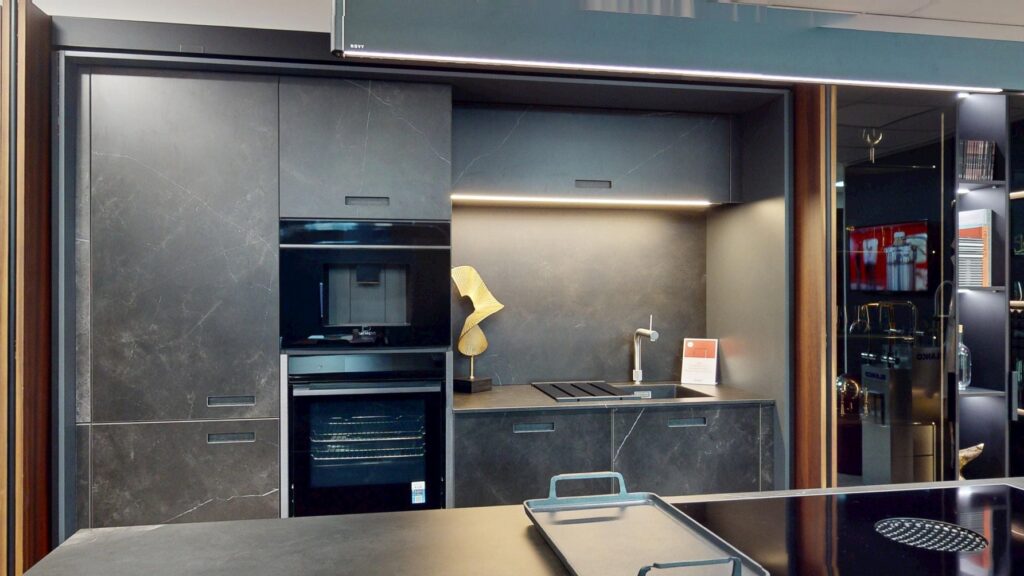
stages 1 to 3: design and planning (weeks 1–9, approximately)
The design process runs for roughly 5 to 9 weeks and is the stage most homeowners underestimate. Stage 1 – discovery – is not simply a chat about what you like. It is where your designer builds a working understanding of how your household uses a kitchen: cooking patterns, who else is in the space, what frustrates you about the current layout, what you’d fight to keep. That conversation shapes every decision that follows.
Stage 2 (concept design) translates the discovery brief into initial floor plans and a mood direction. Layouts are explored at this point, the broad specification begins to take shape, and you get a clear sense of which brand and range sits best with the space and the budget. Schüller’s range, for instance, offers considerable flexibility in both finish and configuration, which is why narrowing the specification at this stage rather than the next makes the detailed design work faster and cleaner.
Stage 3 (detailed design and technical) is where the design is locked. Every cabinet is specified by exact dimensions, appliances are selected and their spec sheets confirmed, a technical drawing pack is produced for any builders involved, and the final quotation is agreed. This stage takes longer than most clients expect because precision matters at this point: a worktop template error identified here costs nothing to correct; discovered during installation, it costs weeks and real money. If you are having a building extension, your designer will also need confirmed builder drawings at this stage to coordinate kitchen placement with services, glazing and ceiling heights, which is one reason involving your kitchen designer before building regs are submitted is advisable, not after the extension is built.
According to the Kitchen, Bedroom & Bathroom Specialists Association (KBSA), thorough planning at the design stage is the single most effective way to prevent delays and cost overruns during installation.
stage 4: why manufacture takes 8 to 14 weeks – and why that is a strength
Manufacture is the single longest stage in any German kitchen project, and it is the one clients most often push back on. Schüller kitchens are manufactured to order at the factory in Herrieden, Bavaria. Each cabinet is built to the exact dimensions specified in your design, there is no warehouse of pre-made units waiting to be picked and dispatched. The manufacturing tolerance across the Schüller range is ±0.5mm, compared to ±2mm or more on standard stock-built cabinetry.
That means 8 to 14 weeks from order confirmation to delivery. Where your project lands in that range depends on the complexity of the specification, the finish options selected, and factory scheduling at the point you order. Lead times can edge towards the longer end during peak periods, typically spring and autumn — when demand is highest across European markets.
The trade-off is worth understanding clearly. Chain retailers can turn around cabinets in 4 to 8 weeks because they hold stock. But that stock is standardised, limited sizes, limited finishes, limited configuration options. A German kitchen built to order arrives as your design, not a close approximation of it. The manufacturing precision also means less remedial adjustment is needed during installation, because the cabinets arrive fitting the space as specified, not requiring on-site adaptation.
stages 5 and 6: site survey and installation
One week before delivery, your installer carries out a final pre-install site survey. This is not a duplicate of the design-stage measurements – it is a systems check. The site is assessed in full: are the walls square? Has the plaster thickness changed since the design visit? Have services moved? Is the floor level consistent across the room? Any discrepancy found at this point is far easier to resolve than one found with a delivery lorry on the drive.
Installation itself typically takes 2 to 3 weeks for a standard kitchen project. The first week covers cabinet installation and structural work – plinths, cornices, any boxing-in around pipes or boilers. The second week brings worktop templating (usually a separate specialist visit), worktop fabrication, and then fitting, followed by appliance installation and connection. The third week is finishing: splashbacks, lighting, final adjustments, and plumbing sign-off.
Projects involving extensions typically run 4 weeks or longer. The timeline is more variable because installation progress depends on the build being genuinely ready – and build readiness is the most common cause of kitchen-side delay. If you are managing a fitted kitchen installation in Altrincham alongside a wider build project, building in a two-week buffer between confirmed build completion and installation start date is practical risk management, not pessimism.
stage 7: snagging and sign-off
Snagging is the structured review of the completed installation against the design specification. At Suga Küchen, this is a formal process – every door alignment, every drawer operation, every appliance connection, every visible gap is checked against the agreed design. Items that do not meet the specification are logged and resolved. Most snags are addressed within the snagging window; occasionally a replacement component is needed, which may require a follow-up visit.
Sign-off happens when the client is satisfied and the snagging list is clear. That is also the point at which the warranty period for the installation begins. German-manufactured cabinets carry a 5-year manufacturer warranty as standard; structural elements are often covered for longer. Keeping your design documentation, product codes and order confirmation from this stage makes any future warranty claim significantly more straightforward.
the full timeline at a glance
This Gantt-style table shows a typical project for a homeowner whose first design meeting takes place in early January. Dates are illustrative and assume a mid-complexity project with no structural extension component.
| Stage | Week from Start | Approx. Calendar Month |
|---|---|---|
| Discovery | Weeks 1–2 | Early January |
| Concept design | Weeks 2–5 | January – early February |
| Detailed design + technical | Weeks 5–9 | Late January – late February |
| Order placed | Week 9 | Late February |
| Manufacture | Weeks 9–22 | March – mid June |
| Pre-install site survey | Week 21 | Early June |
| Installation | Weeks 22–25 | Mid June – early July |
| Snagging + sign-off | Weeks 25–26 | July |
A project starting in late February or March – which is a common point at which Altrincham and Cheshire homeowners begin the process after January research – would typically reach sign-off in August or September. For projects involving extensions, add 4 to 8 weeks to the installation phase, depending on build progress.
The question I’m asked most often is ‘can we speed this up?’ – and the honest answer is: you can compress some stages, but not without cost. The design and technical stages exist to catch problems before the kitchen is made. Manufacture can’t be rushed – it’s factory-scheduled. What you can control is how quickly you make decisions. The projects that run fastest are the ones where clients arrive with a clear brief and make appliance choices early. The projects that slip are usually waiting on a decision that felt low-priority but was sitting on the critical path – a worktop material, an appliance upgrade, a colour confirmation.
To experience our kitchens in person, arrange a visit to the Suga Küchen showroom and see the materials, finishes and details up close.
common mistakes to avoid
Ordering the kitchen before the building work is structurally complete. If the extension is still in progress, a service location change or ceiling height revision can invalidate part of the design. Finalise the kitchen specification only once ceiling heights, floor levels and service positions are confirmed.
Assuming delivery and installation can happen in the same week. The pre-install site survey needs to take place first, and the site needs to be genuinely ready. Delivery and fit on the same day is rarely achievable in practice.
Underestimating appliance lead times. Certain models from premium brands carry lead times comparable to the kitchen itself – 8 to 12 weeks is not unusual. Selecting and ordering appliances alongside the kitchen, rather than afterwards, avoids holding up the installation.
Not building a buffer into the build programme. If the kitchen installation is timed to immediately follow a builder’s stated finish date, add at least two weeks of float. Build completion dates move more often than they hold.
Conflating installation weeks with calendar weeks. A three-week installation involves multiple trades -cabinet fitters, worktop templaters, worktop fabricators, plumbers, electricians. Not all work simultaneously, and gaps between visits are part of the process, not delays.
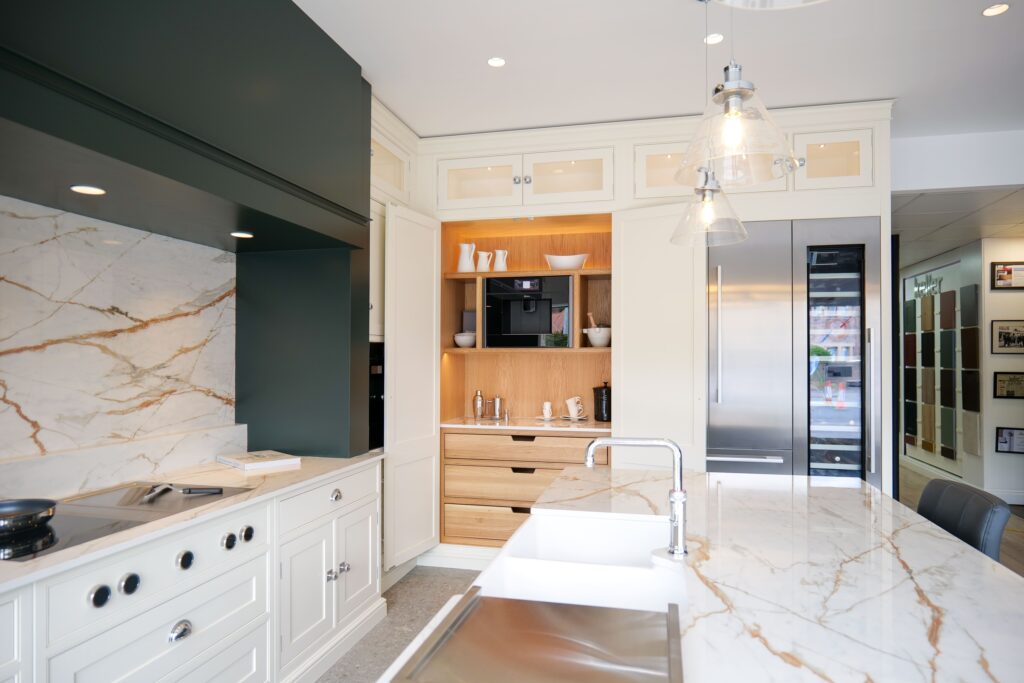
frequently asked questions
Can I rush a German kitchen?
The manufacture stage – 8 to 14 weeks – is fixed by factory scheduling and cannot meaningfully be shortened. Some compression is possible in the design stages if decisions are made quickly and without revision. The most effective way to shorten the overall project is to arrive at your first design meeting with a clear brief, make appliance selections within the first two design stages, and avoid late changes to the specification after order is placed.
Why does manufacture take so long?
German cabinets are built to order, not picked from warehouse stock. Each unit is manufactured to the exact dimensions and finish specified in your design. Schüller’s factory in Herrieden, Bavaria operates this way across its entire product range. The precision this enables – manufacturing tolerances of ±0.5mm – is directly connected to how well the cabinets fit on site, and why remedial adjustment is far less common than with stock-based kitchens.
What part of the timeline slips most often?
The most common point of slippage is the transition from manufacture to installation, particularly on extension projects. If building work is behind schedule, the kitchen arrives before the site is ready and installation must be rescheduled – sometimes by several weeks. Committing to an installation slot before the build is confirmed as genuinely complete is a risk worth managing carefully.
Do bank holidays affect kitchen lead times?
They can, particularly German public holidays, which do not align with the UK calendar. The Schüller factory observes German national holidays, including Bavarian regional holidays in October and the Christmas shutdown period. If your order is placed in September or October, ask your designer specifically whether any German holiday periods fall within your lead time window and factor that into your install slot.
Should I order my kitchen before the building work is finished?
It depends on how much of the design is affected by the build. If your kitchen is going into an existing room with no structural changes, ordering before the wider build finishes is fine – and given lead times, often necessary to avoid a long wait. If the kitchen is in a new extension, do not finalise the design until ceiling heights, floor levels and service positions have been confirmed by your builder in writing.
Can I live in my home during the kitchen installation?
Usually, yes. Most clients remain in the property during installation, using a temporary setup in another room – microwave, kettle, portable hob, and access to a bathroom sink for washing up. The noisiest and dustiest work happens in week one. By week two, cabinets are in place and the space is usable in a basic way. Full cooking function is typically restored by the end of week three, subject to appliance connection and plumbing sign-off.
Ready to understand your timeline?
Wherever you are in your kitchen plans, a short conversation with one of our designers can save weeks of second-guessing. Chat with a designer, no pressure, no sales pitch, just practical guidance grounded in real installation experience.